



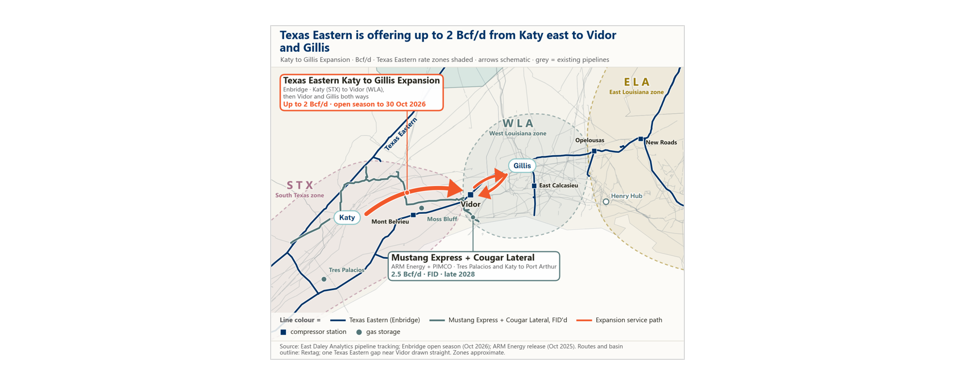
Enbridge (ENB) is working with ARM Energy Holdings on pipeline expansions to move gas supply from Katy to the Gillis hub in southwestern Louisiana, to feed Port Arthur LNG and potentially other projects. The expansions are targeting a bottleneck East Daley Analytics has flagged that could stymie lofty growth expectations for LNG exports.
ENB subsidiary Texas Eastern Transmission (TETCO) opened a non-binding open season on Oct. 7 for the Katy to Gillis Expansion. The project aims to deliver up to 2 Bcf/d from Katy to Gillis, a key hub for LNG projects planned in Louisiana.
Under the offering, TETCO would enter into firm transport agreements with Mustang Express Pipeline, a new 2.5 Bcf/d intrastate pipeline ARM is developing with financial partner PIMCO. Mustang Express would deliver gas from Katy to Vidor, TX, near Port Arthur. Shippers would then use TETCO’s Zone WLA system to move gas from Vidor to the Gillis hub.
Responses to the open season are due by Oct. 30. TETCO is targeting an in-service date of 1Q31.
Mustang Link is Key to Project
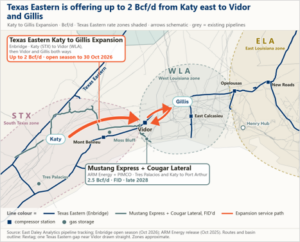 ARM Energy’s Mustang Express is the linchpin of the coordinated expansions. The 236-mile project is backed by an anchor commitment with Sempra Energy (SRE) to support the Phase 2 expansion at Port Arthur LNG.
Mustang Express includes three 42-inch pipe segments: a 178-mile mainline from the Katy hub to Port Arthur, a 55-mile pipeline (the Cougar lateral) from the Tres Palacios storage facility to Katy, and a 3-mile lateral to the Golden Triangle/Spindletop storage fields near Port Arthur.
ARM announced a final investment decision on Mustang Express in October 2025. The project has financial backing from PIMCO and other investors at an estimated $2.3B cost. The partners plan to start service by late 2028 or early 2029.
Sempra’s Port Arthur Phase 2 expansion includes three trains totaling ~13 Mtpa of LNG export capacity, or around 1.7 Bcf/d of feedgas demand. If SRE signed up for all of its feedgas needs, it would leave ~800 MMcf/d of capacity on Mustang Express for other LNG or industrial customers at the current scope, and potentially more if ARM upsizes Mustang Express.
In the Houston Ship Channel Supply & Demand report, East Daley models Mustang’s capacity in place by late 2028 and flowing ~1.0 Bcf/d from the middle of 2030 through 2031, growing to 1.9 Bcf/d in 2032. If fully subscribed and utilized, Mustang Express could spawn other expansions along the TX/LA corridor.
According to the TETCO open season, Mustang has identified other expansion opportunities to Vidor above its initial design, and would pursue them if favorable shipper demand emerges.
LNG Growth Could Hit the Wall at Gillis
The TETCO and ARM projects are targeting an underappreciated bottleneck in the natural gas value chain. East Daley reviews the problem in The LNG Reckoning, our latest white paper examining trends in the natural gas market.
Feedgas demand for LNG exports is on track to grow 28 Bcf/d by 2035; a large share of that growth will come from projects based in southwestern Louisiana and the Golden Triangle in Texas. The Permian Basin will supply a big share of new demand, pushing gas moving into the Katy hub through projects like WhiteWater’s Eiger Express and Solitude. But the supply must then be moved from Katy into Louisiana, and here current pipeline infrastructure falls short of the task.
In The LNG Reckoning, we forecast committed capacity into Gillis is exhausted by 2031. This means that many emerging LNG projects have a narrow window, through around 2027, to sanction new pipeline projects and secure feedgas in time to meet startup schedules. A 1Q31 target for the TETCO expansion would fall just inside that window.
TETCO’s own footprint through the TX/LA corridor is modest at current design. East Daley models just 600 MMcf/d of capacity on the system from the Houston Ship Channel to Louisiana, currently flowing ~50 MMcf/d. The project depends on new Mustang infrastructure delivering more supply into the TECTO system.
The timing fits the looming infrastructure crunch. We see HSC-to-Louisiana flows rising from 2.2 Bcf/d today to 8.1 Bcf/d in 2030. The Trident project (2.0 Bcf/d, 2027 ISD) and Mustang add 4.5 Bcf/d of capacity, while flows on Blackfin/CP Express, already in the capacity base, ramp from zero to 3.5 Bcf/d by late 2028.
Investor Takeaway: Growth in LNG exports will require investments along the gas value chain, and the Gillis hub is a prime target. Mustang Express and the TETCO expansion will help ease tightening takeaway into Gillis, but additional infrastructure will still be needed to meet the 28 Bcf/d of LNG demand growth that we expect. – Alec Gravelle and Andrew Ware Tickers: ENB, SRE.
Introducing The LNG Reckoning, East Daley’s Latest White Paper
East Daley Analytics has published our latest white paper, The LNG Reckoning. Surging LNG exports are colliding with new data center demand, setting the stage for disruptions in the US natural gas market. We view midstream, not resources, as the primary bottleneck, and expect problems to emerge based on the interdependency of energy commodity chains. In The LNG Reckoning, we identify the potential choke points ahead. Download a copy now.
How Will Data Centers Affect Development in the Permian Basin?
Data centers are adding significant, non-intermittent demand for natural gas. What could that mean for Permian production and infrastructure?
Join East Daley on Oct. 28 at 10 am MT for a look at how growing gas demand could reshape the region’s natural gas, crude oil and NGL markets.
We’ll cover:
- Natural gas: Permian demand is growing from Gulf Coast pipeline expansions and gas-fired power generation supporting data centers. The basin could very become short gas – a strange paradox for a basin that has been notoriously constrained in the past.
- Crude: As gas demand and egress capacity grow, producers could shift toward gassier windows in the Delaware and Midland basins, producing more associated gas alongside lower oil volumes. We’ll consider how that could ease crude egress pressure, and how much new oil pipeline capacity might be needed beyond potential brownfield expansions.
- NGLs: Higher Waha prices could encourage more ethane rejection, while new very large ethane carriers (VLECs) are expected to be built over the next several years. We’ll explore the tug-of-war between rejection at the wellhead and growing demand at the dock — and what it could mean for ethane production.
Register now before spots fill up to hear East Daley’s analysis of the infrastructure and production shifts shaping the Permian.
The Daley Note
Subscribe to The Daley Note for energy insights delivered daily to your inbox. The Daley Note covers news, commodity prices, security prices and EDA research likely to affect markets in the short term.