



The massive Solitude Pipeline system adds an exclamation point to a new era in the Permian Basin: the end of longstanding gas constraints, and the likely dawn of new bottlenecks downstream and for other commodities.
WhiteWater, together with partners Devon Energy (DVN), MPLX, Diamondback Energy (FANG) and Western Midstream (WES), last Monday (Aug. 17) announced a positive final investment decision (FID) for Solitude, a new long-haul project moving Permian gas to the Katy hub on the Gulf Coast.
 Solitude consists of two 48-inch pipelines built in phases: 2.25 Bcf/d in service in late 2029, followed by 2.25 Bcf/d in 2030, amounting to 4.5 Bcf/d of total nameplate capacity. The sponsors also flagged room to upsize beyond the initial build.
WhiteWater will own 50% of Solitude, followed by DVN (25%), MPLX (10%), FANG (7.5%) and WES (7.5%). The ownership structure is similar to WhiteWater’s other Permian pipeline joint ventures, including Whistler, Blackcomb and Matterhorn Express.
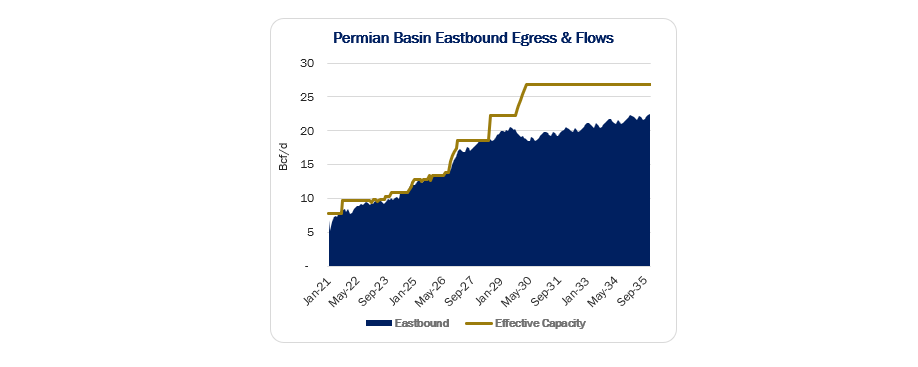
Layered onto East Daley Analytics’ current Permian eastbound egress model in Energy Data Studio, Solitude looks like an overbuild. The stack of projects already sanctioned (Blackcomb, Hugh Brinson, Eiger Express) lifts eastbound nameplate capacity to 22.3 Bcf/d by mid-2028, but our modeled volumes don’t catch up to that capacity until 2035 (see figure). Utilization actually softens to ~80% in 2029-32 as the last tranche of pipe fills. Along with the new eastbound pipes, Energy Transfer’s (ET) Desert Southwest will compete for supply during this period to move Permian gas west.
Stacking on Solitude’s 4.5 Bcf/d of capacity pushes total eastbound nameplate to roughly 26.8 Bcf/d by 2030. We currently model volumes to flow in the high-teens/low-20s Bcf/d, implying low- to mid-70% utilization for several years before even factoring in the upsize option.
Underutilized egress capacity should relieve the risk of bottlenecks out of the basin and support Waha prices. We expect the Waha-Henry Hub spread to narrow as Solitude phases in, reducing the odds of the periodic blowouts tied to constrained takeaway.
On the supply side, Devon and Diamondback’s equity stakes may reflect more than diversification. FANG has been increasingly vocal about deeper, gassier Woodford/Barnett benches in the Delaware, and both producers’ upside there could be the volume growth needed to fill this pipe on schedule. – Alec Gravelle Tickers: DVN, ET, FANG, MPLX, WES.
One Market, One Model: Gain a Holistic View of North America Supply & Demand
East Daley Analytics is pleased to announce the Canada Supply & Demand report. The Canada S&D completes our North American model, providing a fully integrated supply and demand forecast for crude oil and natural gas. East Daley follows molecules from Canadian production through US infrastructure to end-markets. Clients now have a continental view to anticipate trends, from how Canadian gas is reshaping Midwest markets, to how crude imports flow to Gulf Coast refiners. The Canada S&D report and dataset is available exclusively in Energy Data Studio. Reach out to learn more about East Daley’s North American energy model.
The Daley Note
Subscribe to The Daley Note for energy insights delivered daily to your inbox. The Daley Note covers news, commodity prices, security prices and EDA research likely to affect markets in the short term.