



Executive Summary:
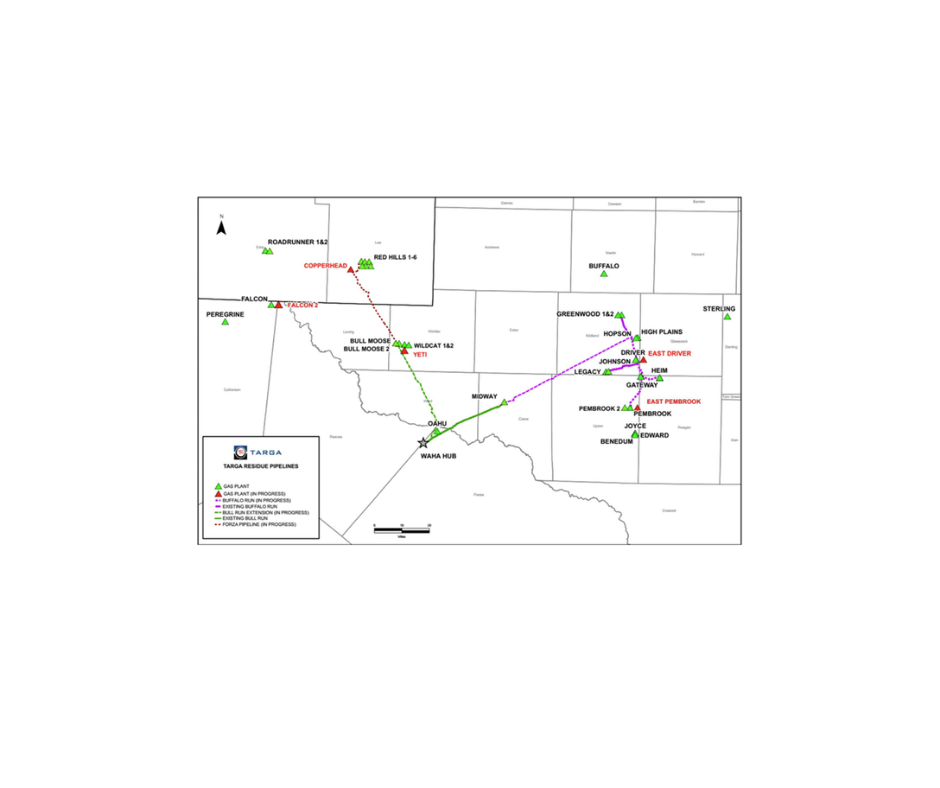
Infrastructure: Targa Resources is constructing several gas pipelines in the Permian Basin to better connect the company’s sprawling G&P footprint in West Texas and New Mexico to the Waha hub.
Rigs: The US rig count decreased by 3 for the week of Feb. 28, bringing the total rig count to 521.
Flows: US natural gas volumes in pipeline samples gained 0.5% W-o-W, averaging 82.2 Bcf/d for the week ending March 8.
Storage: Traders and analysts expect the EIA to report a 39 Bcf storage withdrawal for the week ending March 5.
Infrastructure:
Targa Resources (TRGP) is laying several gas pipelines in the Permian Basin to better connect the company’s sprawling G&P footprint in West Texas and New Mexico to the Waha hub.
In recent months, Targa has announced three gas pipeline projects within the Permian: the Bull Run Extension, Buffalo Run and the Forza Pipeline. Each is relatively modest in scope, but in aggregate will bring substantial volumes to Waha around the time when several major greenfield pipelines start to the Gulf Coast.
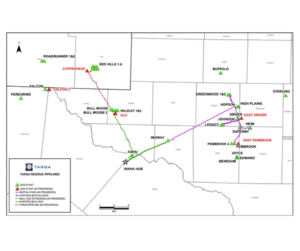
The Bull Run project will extend Targa’s existing 42-inch Bull Run Pipeline in the Delaware by 43 miles to connect to the Waha hub. Buffalo Run is a 35-mile pipeline conversion of an existing line targeting connectivity between several of TRGP’s plant in the Midland. Finally, the Forza Pipeline is a 36-mile, 36-inch interstate pipe that will be capable of moving 750 MMcf/d from Lea County in southeastern New Mexico to delivery points near Waha (see project map from Targa). The Bull Run Extension, Buffalo Run and Forza have expected in-service dates in 1Q27, early 2028 and mid-2028, respectively.
Currently TRGP owns 7.68 Bcf/d of processing capacity between its Delaware and Midland assets. On its 3Q25 earnings call, management stressed confidence in continued Permian volume growth.
According to East Daley Analytics’ “G&P Tool” in Energy Data Studio, TRGP’s Permian plant capacity is expected to increase by 1.3 Bcf/d by 3Q27 from three new expansions: Falcon II (825 MMcf/d), Copperhead (275 MMcf/d) and Yeti (275 MMcf/d). The figure shows the TRGP forecast in Energy Data Studio. Most of these expansions are located in the gassier Delaware sub-basin. The three intrabasin pipeline projects will complement these new plants, allowing TRGP to bring more residue gas to the liquid Waha hub.
The projects also coincide with new Permian egress pipeline connecting Waha to the Gulf Coast. TRGP owns 17.5% of the Blackcomb Pipeline (expected online in late 2026), while Eiger Express is targeted to start in mid-2028. These projects, along with Energy Transfer’s (ET) Desert Southwest and Hugh Brinson pipelines, will open more markets for Permian gas, which has been constrained in recent years by outbound capacity.

Rigs:
The US rig count decreased by 3 for the week of Feb. 28, bringing the total rig count to 521. The Permian (-2), Powder River (-1) and Uinta (-1) lost rigs while the Eagle Ford (+2) gained rigs W-o-W.
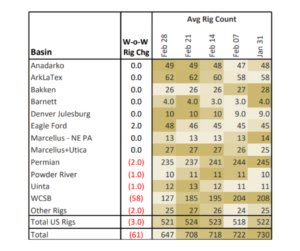
At the company level, Targa Resources (-3), Western Midstream (-3), Williams (-2), M6 Midstream (-2), MPLX (-1), XTO Energy (-1) and Iron Horse Midstream (-1) lost rigs while Energy Transfer (+5), Enterprise (+2), EnLink (+2), ONEOK (+1), Salt Creek Midstream (+1), Summit Midstream (+1), Mustang (+1) and Canes Midstream (+1) gained rigs W-o-W.
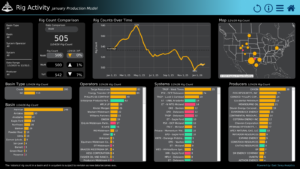
See East Daley Analytics’ weekly Rig Activity Tracker for more information on rigs by basin and company.
Flows:
Note: East Daley has vetted our US pipeline samples and upgraded the data tagging, resulting in a more robust capture of production trends from the daily samples.
US natural gas volumes in pipeline samples gained 0.5% W-o-W, averaging 82.2 Bcf/d for the week ending March 8.
Flows in gas basins increased 1.1% to 51.8 Bcf/d. The Haynesville sample increased 3.7% to 12 Bcf/d, and the Marcellus+Utica gained 0.2% W-o-W at 38.8 Bcf/d.
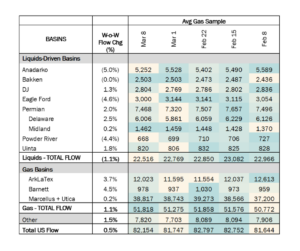
Samples in liquids basins declined 1.1% W-o-W to 22.5 Bcf/d. The Permian sample increased 2.0%, while the Anadarko sample declined 5.0%.
Storage:
Traders and analysts expect the Energy Information Administration (EIA) to report a 39 Bcf storage withdrawal for the week ending March 5. A 39 Bcf draw would decrease the deficit to the 5-year average from -43 Bcf to just -8 Bcf. The surplus to last year would increase to 158 Bcf.
Next week’s EIA report for the week ending March 12 could show an early injection – early estimates predict a net injection of around 20 Bcf. A storage report in this range would flip the current deficit to the five-year average into a surplus.
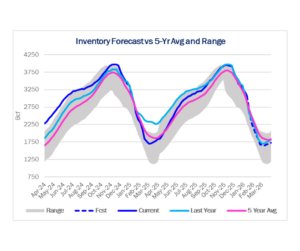
The turmoil in the Middle East has had limited impact on cash and prompt prices, given that LNG projects were already exporting near capacity. The prompt-month April ’26 contract has settled in a range around $3.05/MMBtu while Henry Hub cash is a little higher at $3.10. From a weather perspective, the next two weeks look pretty benign with a mix of lower-than-normal heating degree days for the next eight days and a brief period of higher-than-normal degree days to close out the week ending March 20.
See East Daley’s latest Macro Supply & Demand Report for more on the winter market outlook.
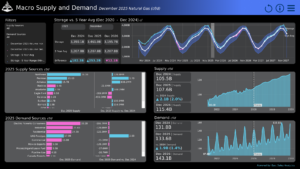
Subscribe to East Daley’s The Daley Note (TDN) for midstream insights delivered daily to your inbox. The Daley Note covers news, commodity prices, security prices, and EDA research likely to affect markets in the short term.