



Executive Summary:
Infrastructure: Backers of the Eiger Express Pipeline will expand the project to 3.7 Bcf/d after securing additional firm transportation agreements, making an overbuild more likely in the Permian Basin.
Rigs: The US rig count increased by 1 for the week of Nov. 29 to 520.
Flows: US natural gas volumes in pipeline samples averaged 69.9 Bcf/d for the week ending Dec. 7, down 1.1% W-o-W.
Storage:The EIA reported a 177 Bcf withdrawal for the week ending Dec. 5.
Infrastructure:
The Permian gas overbuild continues to grow. The WhiteWater-led joint venture behind Eiger Express Pipeline will expand the greenfield project to 3.7 Bcf/d after securing additional firm transportation agreements.
The announcement on Nov. 24 comes just months after the project was first unveiled at an initial capacity of 2.5 Bcf/d. The expansion will see the 42-inch mainline upped to 48 inches and add additional compression, bringing pipeline capacity to 3.7 Bcf/d.
The Eiger Express consortium includes WhiteWater (65%), ONEOK (OKE, 15%), MPLX (15%) and Enbridge (ENB; 10%), the same group behind Matterhorn Express Pipeline. The investors don’t expect the expansion to impact Eiger’s in-service date and are still targeting mid-2028 to begin flowing gas.
Eiger Express will open additional egress from the Permian Basin to the Katy hub near Houston once completed. The Permian has seen constrained egress capacity in recent years, which has kept Waha prices suppressed, but a slate of green- and brownfield projects entering service over the next few years is expected to produce an overbuild for the basin.
In the Permian Supply & Demand model, East Daley Analytics forecasts over 10 Bcf/d of new Permian gas takeaway through 2030 based on projects with a final investment decision (FID). Along with Eiger Express, WhiteWater’s Blackcomb Pipeline (+2.5 Bcf/d) and ET’s Hugh Brinson Pipeline (+2.2 Bcf/d) are scheduled to start through 2027. Eiger Express and ET’s Desert Southwest (+1.5 Bcf/d) will add more takeaway by the end of the decade. Our outlook does not include other potential expansions on Hugh Brinson, Desert Southwest, or Tallgrass Energy’s proposed Permian-to-Rockies Express connector.

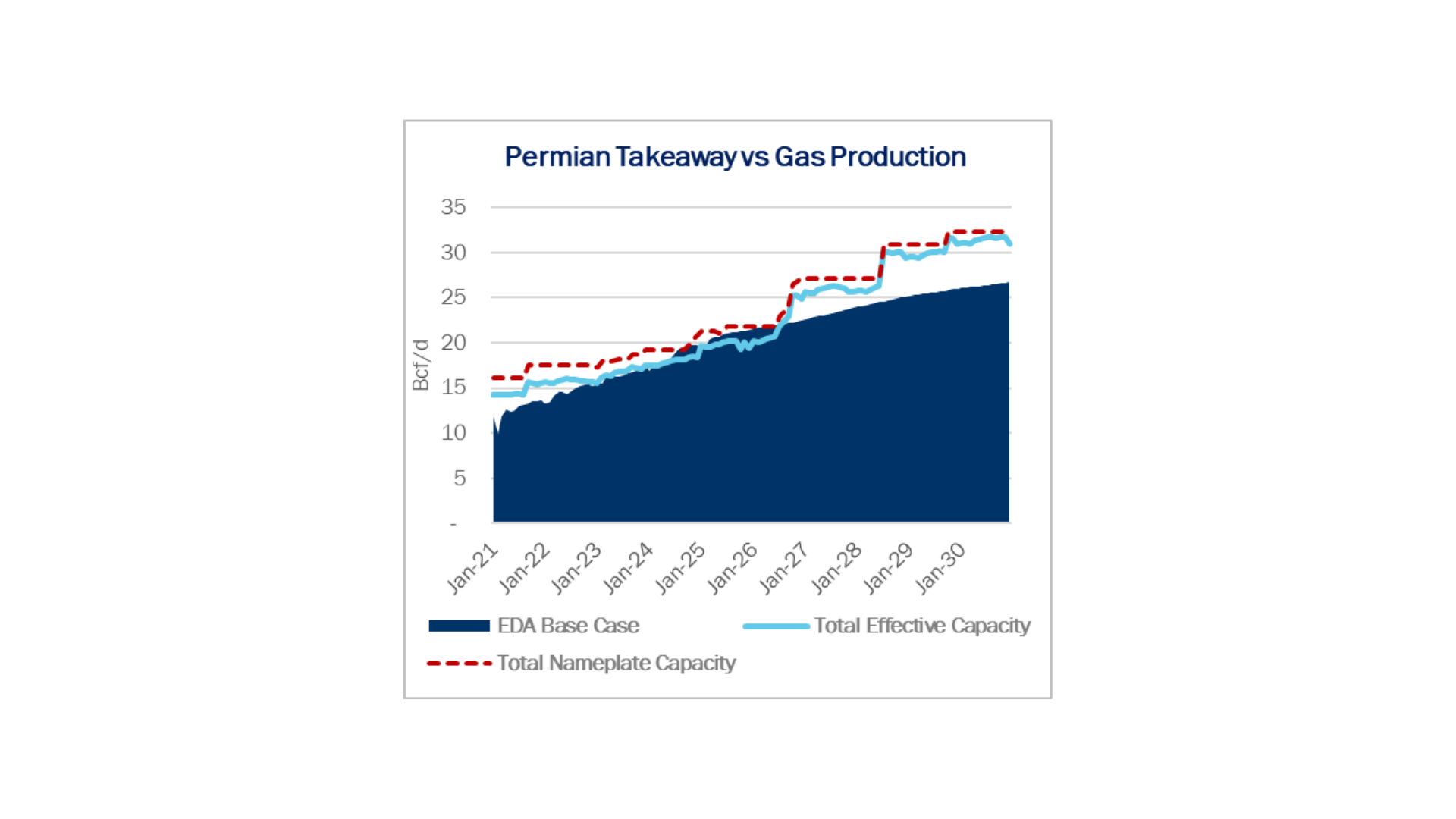
In the Permian Supply & Demand model, we forecast Permian dry gas production to average just below 20 Bcf/d for 2025, maxing out effective capacity out of the basin. We predict production rises to nearly 27 Bcf/d by 2030 as producers move to gassier plays in the basin, but with the additional 1.2 Bcf/d from the Eiger Express expansion, the Permian will have over 30 Bcf/d of effective egress capacity (see figure).
This overbuild will likely sustain higher Waha prices as growing demand increases competition for molecules. But while most of the Permian’s new pipe projects are backed by firm transportation agreements, production could fail to grow into the available egress if WTI prices remain low and disincentivize drilling, which could lead to these new projects being underutilized.

The Permian Basin at a Crossroads: Download Why This Pipeline Boom is Different
The Permian’s next big buildout is already taking shape — but this time, the drivers aren’t producers chasing oil. East Daley’s latest white paper reveals how gas demand from AI data centers, LNG exports, and utilities is rewriting the midstream playbook. Over 9 Bcf/d of new capacity and $12 billion in investments are reshaping flows, turning the Permian into a gas powerhouse even as rigs decline. Read Part II: Why This Pipeline Boom is Different
Rigs:
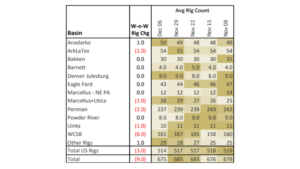
The US rig count declined by 3 for the week of Dec. 6, bringing the total count to 514. The Permian (-2), ArkLaTex (-1), Marcellus+Utica (-1) and Uinta (-1) lost rigs while the Anadarko (+1) gained rigs W-o-W.
At the company level, Energy Transfer (-4), MPLX (-3), Kinder Morgan (-3), Summit Midstream (-2), Enterprise (-2), Phillips 66 (-1), EnLink (-1), ONEOK (-1) and Aethon Energy (-1) lost rigs while Western Midstream (+3), Energy Transfer (+1), Kinetik (+1), DT Midstream (+1), Salt Creek Midstream (+1) and Tallgrass Energy (+1) gained rigs W-o-W.
See East Daley Analytics’ weekly Rig Activity Tracker for more information on rigs by basin and company.
Flows:
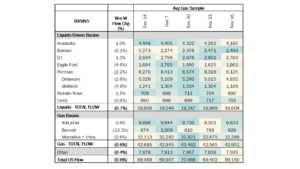
US natural gas volumes in pipeline samples averaged 69.5 Bcf/d for the week ending Dec. 14, down 0.6% W-o-W.
Major gas basins declined 0.6% W-o-W to average 42.7 Bcf/d. The Haynesville sample gained 0.6% to 9.7 Bcf/d, while the Marcellus+Utica slid 0.6% to 32.1 Bcf/d. The Barnett sample declined 13.3% W-o-W.
Samples in liquids-focused basins decreased 0.7% to 18.9 Bcf/d. The Permian sample declined 2.2% to 6.3 Bcf/d, and the Eagle Ford sample fell 4.6% W-o-W.
Storage:
Traders and analysts expect the Energy Information Administration (EIA) to report a 173 Bcf storage withdrawal for the week ending Dec. 12. A 173 Bcf draw would shrink the surplus to the five-year average by a massive 77 Bcf and leave it at just 26 Bcf, the smallest surplus since the week ending April 25. If estimates are accurate, the storage deficit to a year ago would increase to 70 Bcf.
With cold weather continuing in eastern markets, it’s likely that storage this week will move from surplus to deficit conditions compared to the five-year average, a scenario EIA will confirm next Wednesday (Dec. 24). The surplus to the five-year average has lasted 33 weeks (8 ½ months), a much shorter duration than the last surplus period that spanned most of 2023 and 2024.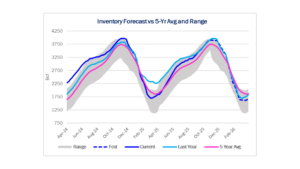
In our near-term forecast, East Daley expects deficit storage conditions to persist through the end of March, followed by a brief respite in surplus territory through mid-June. We forecast gas-fired power burn and amped-up LNG feedgas demand over the 2026 summer will drive the market into a deficit for the balance of 2026 and the first half of 2027.
See East Daley Analytics’ latest Macro Supply & Demand Report for more analysis on the winter market outlook.
Subscribe to East Daley’s The Daley Note (TDN) for midstream insights delivered daily to your inbox. The Daley Note covers news, commodity prices, security prices, and EDA research likely to affect markets in the short term.