



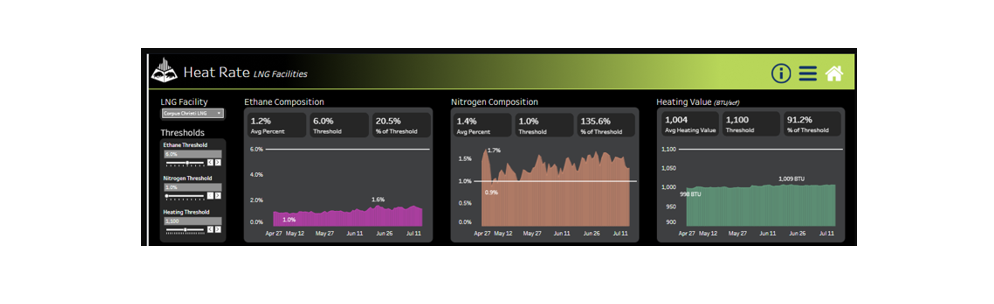
Elevated nitrogen content in natural gas flowing from the Permian Basin is creating operational hazards for some LNG exporters. The problem is particularly acute at Cheniere Energy’s (LNG) Corpus Christi facility, according to East Daley Analytics’ monitoring of feedgas quality at LNG projects.
Daily gas composition data shows Corpus Christi LNG is receiving gas with the highest nitrogen concentration among major US LNG facilities. The data, now available in the ‘LNG Heat Content’ dashboard in Energy Data Studio, shows Corpus Christi has taken in gas with an average 1.3% nitrogen content since April 27 (see figure below). This is 35% over the commonly referenced 1.0% threshold to assure normal operations at LNG plants.

By comparison, feedgas to Sabine Pass LNG averaged just 0.16% nitrogen content over the same period, while flows to Cove Point averaged 0.28% nitrogen content, making Corpus Christi a clear outlier among the facilities we analyze.
East Daley tracks gas quality data on electronic bulletin boards (EBBs) for interstate pipelines and, in the case of Corpus Christi LNG, Cheniere’s Corpus Christi Pipeline. Our estimates do not include flows from WhiteWater’s ADCC intrastate line, which also delivers to the Corpus Christi terminal.
 Nitrogen is an inert component of natural gas and does not contribute to heating value. Since nitrogen boils at a much lower temperature than methane, rich nitrogen feeds can overload a liquefaction plant’s vapor handling and compressor loops.
Elevated nitrogen has become a growing concern for some LNG facilities as new pipelines have pushed more nitrogen-rich Permian gas to the Gulf Coast. Corpus Christi is located between the Katy and Agua Dulce hubs, the two delivery points for recent pipelines like Whistler and Matterhorn Express.
The nitrogen issue is not likely to go away anytime soon. More Permian-based pipelines such as Blackcomb and Eiger Express are due to deliver to Katy and Agua Dulce in the next several years, while new LNG projects (Rio Grande LNG, Texas LNG) are coming to South Texas and are likely to contend with the same problem.
Cheniere executives have acknowledged the gas-quality problem at Corpus Christi and taken several measures to address it, including modifying plant operations and injecting solvents into the gas stream to mitigate the nitrogen. On the company’s 4Q25 earnings call, CEO Jack Fusco said Cheniere is also investing in front-end infrastructure to manage variability in gas content before flows reach the facility.
Along with nitrogen, East Daley tracks the ethane content for feedgas to LNG terminals. In contrast to nitrogen, ethane is a higher-energy hydrocarbon that increases heating value.
Despite receiving gas with a higher average ethane concentration than Sabine Pass, Corpus Christi exhibits the lowest average heating value among the LNG facilities we review. The data suggests elevated nitrogen is an important contributor to this difference in gas quality.
While Corpus Christi’s gas remains within normal operating specifications, the analysis demonstrates that gas composition is an important operational issue as the US LNG export boom unfolds. – Sam Chen Tickers: LNG.
Reading the Signals: Staying Ahead of Gas, Crude & NGL Markets Through Year-End
Volatility is defining today’s energy markets, and East Daley’s July webinar will help make sense of what’s next.
Prices are the signal producers can’t ignore. Natural gas prices remain under pressure while crude oil markets continue to react to geopolitical tensions in the Middle East. When realized prices compress, producers respond: deferring completions, high-grading acreage and re-underwriting economics in real time. The question isn’t whether producers are adapting, it’s how fast, and where the next pressure point emerges.
Infrastructure is the other half of the equation. In the NGL market, rising Waha gas prices, driven by new pipeline capacity, are eroding the cost advantage that’s long favored ethane rejection. In the Permian, the math is even more binding: How much longer can oil and associated gas production keep growing as crude takeaway capacity tightens? Infrastructure doesn’t just move barrels. It sets the ceiling on what producers can economically bring to market.
And none of this happens in isolation. Gas, crude and NGLs are structurally linked through associated production, processing economics and shared basin infrastructure. A shift in one commodity’s price or takeaway capacity ripples through the others, which means forecasting any single molecule in a vacuum gets you the wrong answer.
Join East Daley’s analysts as they connect these dots: breaking down the market forces shaping 2H26, what they mean for producers and midstream operators, and the key indicators to watch in the months ahead.
Click here to register for our July webinar on Wednesday, July 29 at 10:00 am MT.
The Daley Note
Subscribe to The Daley Note for energy insights delivered daily to your inbox. The Daley Note covers news, commodity prices, security prices and EDA research likely to affect markets in the short term.