



A federal appeals court on Sept. 11 vacated a Department of Energy (DOE) order keeping Consumers Energy’s J.H. Campbell coal plant in Michigan operating beyond its planned May 31, 2025 retirement. The ruling could end a leading source of baseload power in the Midwest and boost gas demand.
DOE first ordered the 1.42 GW Campbell plant to remain available in May 2025 to address grid reliability concerns. The agency has subsequently extended the requirement, most recently through Nov. 14, 2026. The appeals court ruling puts the plant’s retirement, and the generation needed to replace it, back in focus.
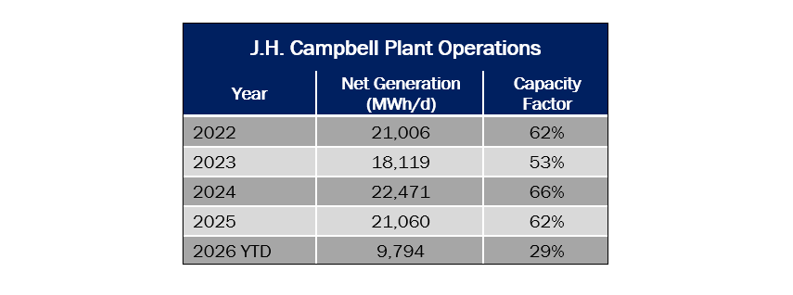
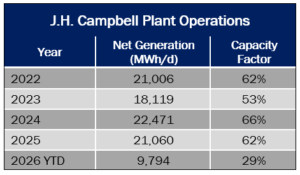 Despite the planned retirement, Campbell has remained relatively well utilized. East Daley’s analysis of EIA generation data shows the plant averaged a 60% capacity factor and about 20,500 MWh/d of generation from 2022-24 (see table). Utilization reached 66% in 2024 and remained at 62% in 2025, but has fallen to 29% YTD in 2026.
The plant’s retirement could create an opportunity for incremental natural gas demand in Michigan. If Campbell’s 1.42 GW of coal capacity were fully replaced by gas-fired generation operating at roughly 80% utilization, the replacement generation would require up to 200 MMcf/d of natural gas.
Michigan gas demand ranges from roughly 2 Bcf/d during the shoulder months to around 5 Bcf/d during winter peaks, meaning additional gas burn from coal-to-gas replacement could provide a meaningful lift.
Coal plant retirements are a key factor supporting new gas demand in the power sector. Across the Midwest part of the Midcontinent Independent System Operator (MISO), the manager of the regional transmission grid, roughly 9.5 GW of coal capacity is scheduled to retire through 2031. Over the same period, the region has nearly 21.2 GW of planned generation and storage capacity, including about 10.9 GW of solar, 6.2 GW of natural gas, 2.2 GW of wind and 1.9 GW of battery storage
The diverse replacement mix means coal retirements are unlikely to translate one-for-one into additional gas burn, although nearly 4 GW of planned gas capacity indicates natural gas will remain an important part of the region’s generation mix.
Campbell is not the only retirement-bound coal plant that DOE has ordered to remain available for reliability purposes. In MISO Midwest, F.B. Culley Unit 2 and R.M. Schahfer Units 17 and 18 represent roughly 950 MW of coal capacity kept available beyond planned retirement dates. Similar DOE orders have applied to Craig Unit 1 in Colorado and Centralia Unit 2 in Washington. Together with Campbell, these units represent ~3.55 GW of coal capacity whose planned retirements have been delayed.
As the Midwest transitions away from coal, natural gas has an opportunity to help replace retiring coal generation. The utilization of retiring coal plants and the pace and mix of replacement capacity will ultimately determine the size of the gas demand opportunity. – Kritika Gaikwad.
One Market, One Model: Gain a Holistic View of North America Supply & Demand
East Daley Analytics is pleased to announce the Canada Supply & Demand report. The Canada S&D completes our North American model, providing a fully integrated supply and demand forecast for crude oil and natural gas. East Daley follows molecules from Canadian production through US infrastructure to end-markets. Clients now have a continental view to anticipate trends, from how Canadian gas is reshaping Midwest markets, to how crude imports flow to Gulf Coast refiners. The Canada S&D report and dataset is available exclusively in Energy Data Studio. Reach out to learn more about East Daley’s North American energy model.
The Daley Note
Subscribe to The Daley Note for energy insights delivered daily to your inbox. The Daley Note covers news, commodity prices, security prices and EDA research likely to affect markets in the short term.