



Executive Summary:
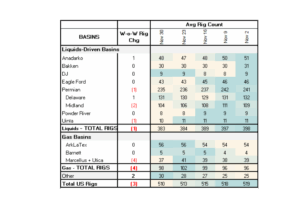
Rigs: The total US rig count decreased during the week of Nov. 30 from 513 to 510.
Infrastructure: Enbridge and Energy Transfer are working together on a project to move Canadian crude oil through the Dakota Access Pipeline in the Bakken.
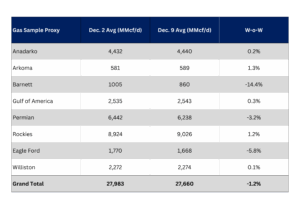
Supply & Demand: The US natural gas pipeline sample, a proxy for change in oil production, decreased 1.2% W-o-W for the Dec. 9 week across all liquids-focused basins.
Rigs:
The total US rig count decreased during the week of Nov. 30 from 513 to 510. Liquids-driven basins lost 3 rigs W-o-W from 384 to 383.
- Anadarko (+1): Landmark Resources
- Uinta (-1): Fourpoint Resources
- Permian:
- Delaware (+1): EOG Resources
- Midland (-2): Exxon, Diamondback Energy
Infrastructure:
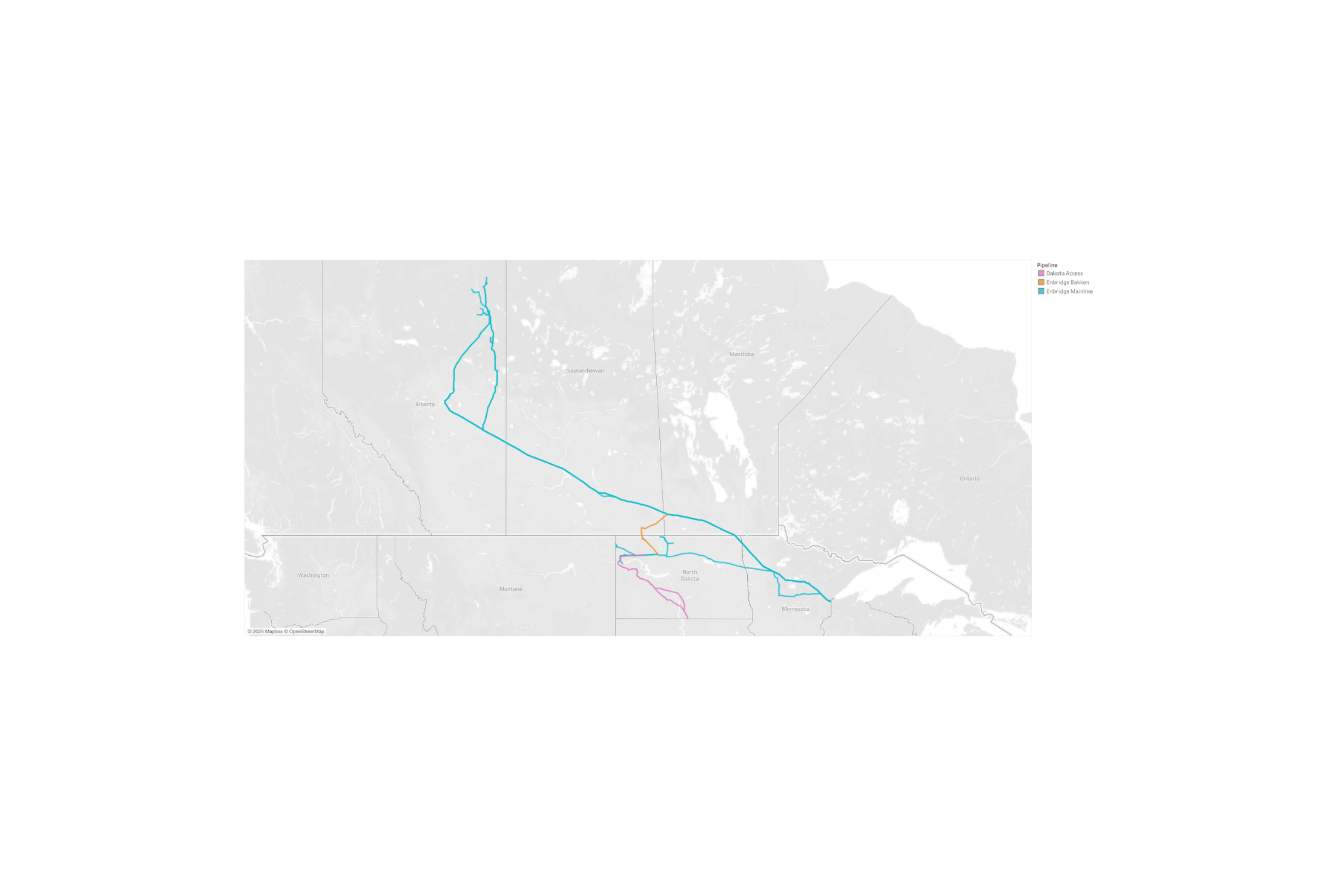
Enbridge (ENB) and Energy Transfer (ET) are working together on a project to move Canadian crude oil through the Dakota Access Pipeline (DAPL) in the Bakken. The companies are sharing few details currently, but East Daley Analytics believes the project involves a reversal of the Enbridge Bakken Pipeline.
Both companies teased the plan on their 3Q25 earnings. ET briefly mentioned a Dakota Access North project, while ENB said it is “advancing Mainline Optimization Phase 2.” The initiative would add 250 Mb/d of capacity to move Canadian barrels onto the DAPL system, they said. ET operates DAPL and has a 38.2% interest, while ENB holds 27.6%. The partners plan to gauge market interest before moving forward and expect a final investment decision (FID) by mid-2026.
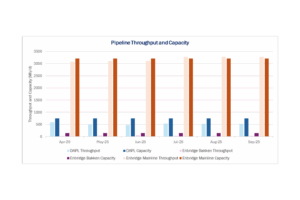
While details are limited, ENB’s assets offer a clear pathway for how Canadian barrels could be routed onto DAPL. The Enbridge Bakken line currently moves light-sweet Bakken volumes north from Minot County, ND to Cromer in Manitoba, where it links into the Mainline. The pipeline is designed to carry ~150 Mb/d of crude but has been notably underused, averaging ~37 Mb/d over the last six months, according to East Daley’s Crude Hub Model.

DAPL can transport 750 Mb/d and has averaged ~512 Mb/d of throughput over the latest six months, suggesting ample room to absorb the incremental volumes envisioned in the project.
The most cost-effective path for moving additional Canadian crude onto DAPL would likely involve reversing the Enbridge Bakken line and sourcing volumes off the Mainline. ENB has reversed this system before, so the concept is not new. Although the Enbridge line and DAPL do not currently interconnect in North Dakota, the two pipes are less than 50 miles apart, meaning only a modest buildout of new infrastructure would be needed to enable Canadian barrels to reach DAPL.
The Permian Basin at a Crossroads: Download Why This Pipeline Boom is Different
The Permian’s next big buildout is already taking shape — but this time, the drivers aren’t producers chasing oil. East Daley’s latest white paper reveals how gas demand from AI data centers, LNG exports, and utilities is rewriting the midstream playbook. Over 9 Bcf/d of new capacity and $12 billion in investments are reshaping flows, turning the Permian into a gas powerhouse even as rigs decline. Read Part II: Why This Pipeline Boom is Different
To accommodate both heavy-sour Canadian crude and light-sweet Bakken crude, DAPL would also need to operate in batched service to manage the differing qualities.
ENB and ET envision adding 250 Mb/d of capacity, yet the Enbridge Bakken line only has 150 Mb/d of nameplate currently. Reaching the targeted throughput would likely require new pump stations or using drag reducing agents (DRAs) to push volumes higher.
The project represents a potential pathway to boost DAPL utilization, offering upside for both Energy Transfer and Enbridge. ENB is primarily focused on expanding the Mainline system currently, but the project could be a feasible option that materializes in the coming years.
Supply and Demand
The US natural gas pipeline sample, a proxy for change in oil production, decreased 1.2% W-o-W for the Dec. 9 week across all liquids-focused basins. The only gains came from the Rockies (+1.2%), Anadarko (+0.2%) and Arkoma (+1.3%). These increases coincided with decreases in the rest of the basins. The most notable decreases occurred from the Barnett (-14.4%), Permian (-3.2%), and Eagle Ford (-5.8%). The Rockies and the Gulf of America have a high correlation between gas volumes and crude oil volumes, whereas the Permian and Eagle Ford basins correlation is less than 45%.
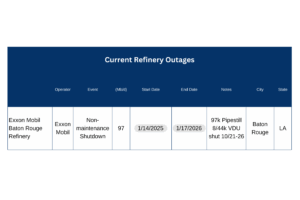
As of Dec. 15, there is currently no refining capacity offline for planned maintenance. In January, a non-maintenance shutdown of 97 Mb/d is expected for half of a week in Exxon Mobil’s Baton Rouge Refinery.
 Vessel traffic monitored by EDA along the Gulf Coast increased W-o-W. There were 31 vessels loaded for the week ending December 6, the highest since The second week of September 2025.
Regulatory and Tariffs:
Presented by ARBO
Tariffs:
Gray Oak Pipeline, LLC: Certain available capacity discounts were increased.
Magellan Pipeline Company, L.P.: The tariffs were revised to add a new product and to update the product grade document to be consistent with ONEOK’s product grade documents.
The above information is provided by ARBO’s Oil Pipeline Tariff Monitor. For more information on regulatory proceedings or tariff rates, please contact please contact Corey Brill via email at [email protected] or phone at 202-505-5296. https://www.goarbo.com/