



Executive Summary:
Rigs: The total US rig count increased during the week of Dec. 28 from 515 to 516.
Infrastructure: WTI prices have reached a threshold that could stall activity in the Permian Basin, the last engine of US oil production growth.
Supply & Demand: The US natural gas pipeline sample, a proxy for change in oil production, increased 1.2% W-o-W across all liquids-focused basins.
Rigs:
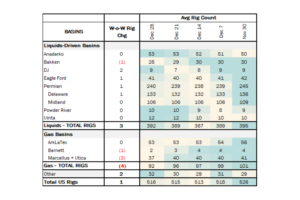
The total US rig count increased during the week of Dec. 28 from 515 to 516. Liquids-driven basins increased 1 rig W-o-W from 389 to 392.
- DJ (+2): Civitas Resources, WEBB Resources
- Eagle Ford (+1): Ineos
- Permian:
- Delaware (+1): Civitas Resources
- Bakken (-1): Continental Resources
Infrastructure:
Crude oil prices plumbed new depths in mid-December, capping off a challenging year for producers. WTI prices reached a threshold that could stall activity in the Permian Basin, the last engine of US oil production growth.
On Dec. 15, WTI fell to ~$55.27/bbl, the lowest close since the world was recovering from the global pandemic in 2021. Consensus opinion expects crude production to flatten or potentially decline in 2026, a result of geopolitical risks and fear of a looming global supply glut.
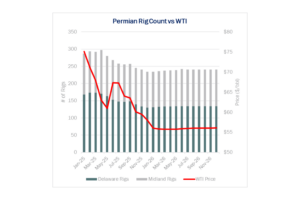
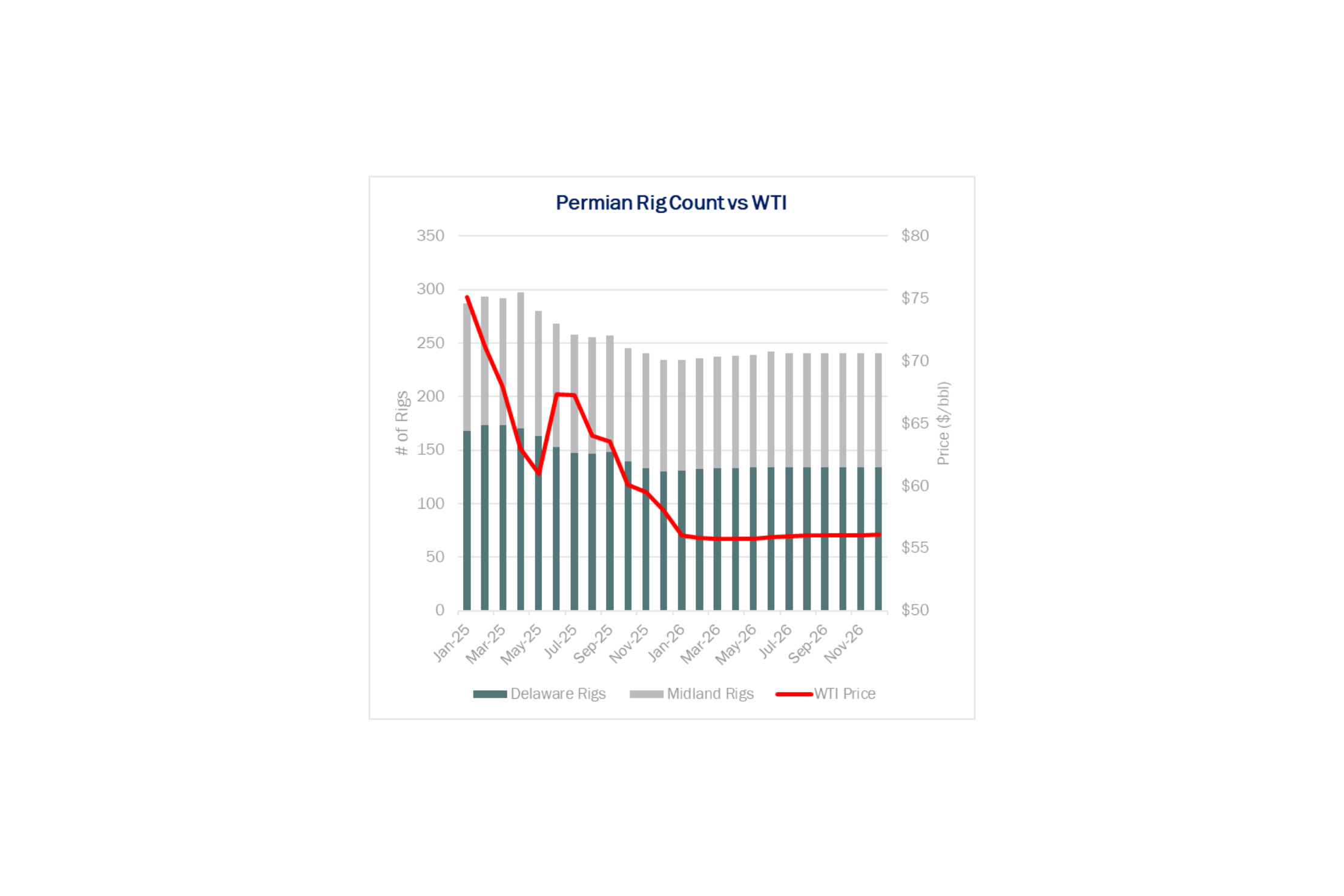
The market is dangerously close to a price where Permian oil supply begins to turn over. Permian rig counts have averaged 240 rigs to date In 4Q25, down ~50 rigs from 1Q025’s 291 rigs between the Midland and Delaware basins.
The Permian Basin at a Crossroads: Download Why This Pipeline Boom is Different
The Permian’s next big buildout is already taking shape — but this time, the drivers aren’t producers chasing oil. East Daley’s latest white paper reveals how gas demand from AI data centers, LNG exports, and utilities is rewriting the midstream playbook. Over 10 Bcf/d of new capacity and $12 billion in investments are reshaping flows, turning the Permian into a gas powerhouse even as rigs decline. Read Part II: Why This Pipeline Boom is Different
In the Crude Hub Model, EDA projects a low point of 235 Permian rigs going into 2026. But if prices continue to tank, we are likely to revise down our rig outlook, and production will be lost in 2026.
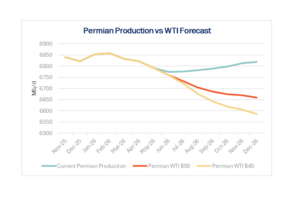
WTI prices of $50 or $45/bbl would have a significant impact on 2026 production in the Permian, based on East Daley Production Scenario Tools (see figure). Enterprise Products (EPD) stated in its 1Q25 earnings call that a WTI price of $55-$60 largely puts producers into maintenance mode.
Producers in other regions are also looking at a prices to determine budgets in 2026. The merging SM Energy (SM) and Civitas Resources, (CIVI) a major producer in the Rockies, stated on their 3Q earnings call that if prices do not reach a $65/bbl target in 2026, they are likely to reduce production and instead focus on reaching goals of net leverage of 1.0x and reducing debt.
The market is punishing producers that plan to grow in the current environment. For example, Matador Resources (MTDR) saw its stock price drop from $43.91 to $39.68 after its 3Q25 earnings call, when MTDR guided to production growth in 2026. Investor concerns are likely to push more producers to pull back.
In 2026, US crude oil production is expected to remain flat, or potentially fall if WTI continues to slide into the lower $50s/bbl. 2026 is an environment with risk of oversupply of crude, and a world hungry for gas molecules, creating push and demand-pull tension in the Permian never seen before.
Supply and Demand
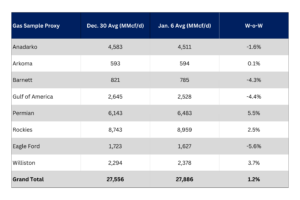
The US natural gas pipeline sample, a proxy for change in oil production, increased 1.2% W-o-W across all liquids-focused basins.
Increases occurred in the Permian by 5.5%, Arkoma by 0.1%, Rockies by 2.5% and Williston by 3.7%. The gains were offset by large decreases in the Eagle Ford (-5.6%), Barnett (-4.3%) and Gulf of America (-4.4%). Also on the decline, Anadarko decreased by 1.6% W-o-W. The Rockies and the Gulf of America have a high correlation between gas volumes and crude oil volumes, whereas the Permian and Eagle Ford basins correlation is less than 45%.
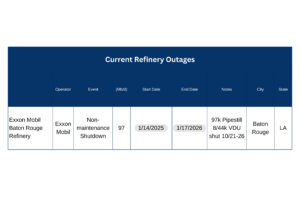
As of Jan. 12, there is currently no refining capacity offline for planned maintenance, as refinery outages remain at a low. This week, a non-maintenance shutdown of 97 Mb/d is expected for a few days at ExxonMobil’s Baton Rouge refinery.
Vessel traffic monitored by EDA along the Gulf Coast increased W-o-W. There were 28 vessels loaded for the week ending Jan. 10, continuing a three week increase from the 18 vessels loaded the week of Dec. 20, 2025.
Presented by ARBO
Tariffs:
Gray Oak Pipeline, LLC: Certain available capacity discounts were increased.
Magellan Pipeline Company, L.P.: The tariffs were revised to add a new product and to update the product grade document to be consistent with ONEOK’s product grade documents.
The above information is provided by ARBO’s Oil Pipeline Tariff Monitor. For more information on regulatory proceedings or tariff rates, please contact please contact Corey Brill via email at [email protected] or phone at 202-505-5296. https://www.goarbo.com/