



Executive Summary:
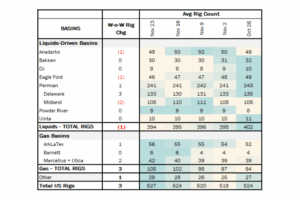
Rigs: The total US rig count increased during the week of Nov. 23 from 524 to 527.
Infrastructure: HF Sinclair (DINO) has thrown its hat in the ring to meet a looming refined products shortfall in California and the Southwest, but with a twist: the company is proposing a project through the Rocky Mountains
Supply & Demand: The US natural gas pipeline sample, a proxy for change in oil production, decreased 0.9% W-o-W across all liquids-focused basins.
Rigs:
The total US rig count increased during the week of Nov. 23 from 524 to 527. Liquids-driven basins decreased by 1 rig W-o-W from 395 to 394.
- Anadarko (-1): Pablo Energy II LLC
- Eagle Ford (-1): Caturus
- Permian:
- Delaware (+3): Civitas Resources, V-F Petroleum, EOG Resources
- Midland (-2): Exxon, Blackbeard Operating LLC
 Infrastructure:
HF Sinclair (DINO) has thrown its hat in the ring to meet a looming refined products shortfall in California and the Southwest, but with a twist: the company is proposing a project through the Rocky Mountains.
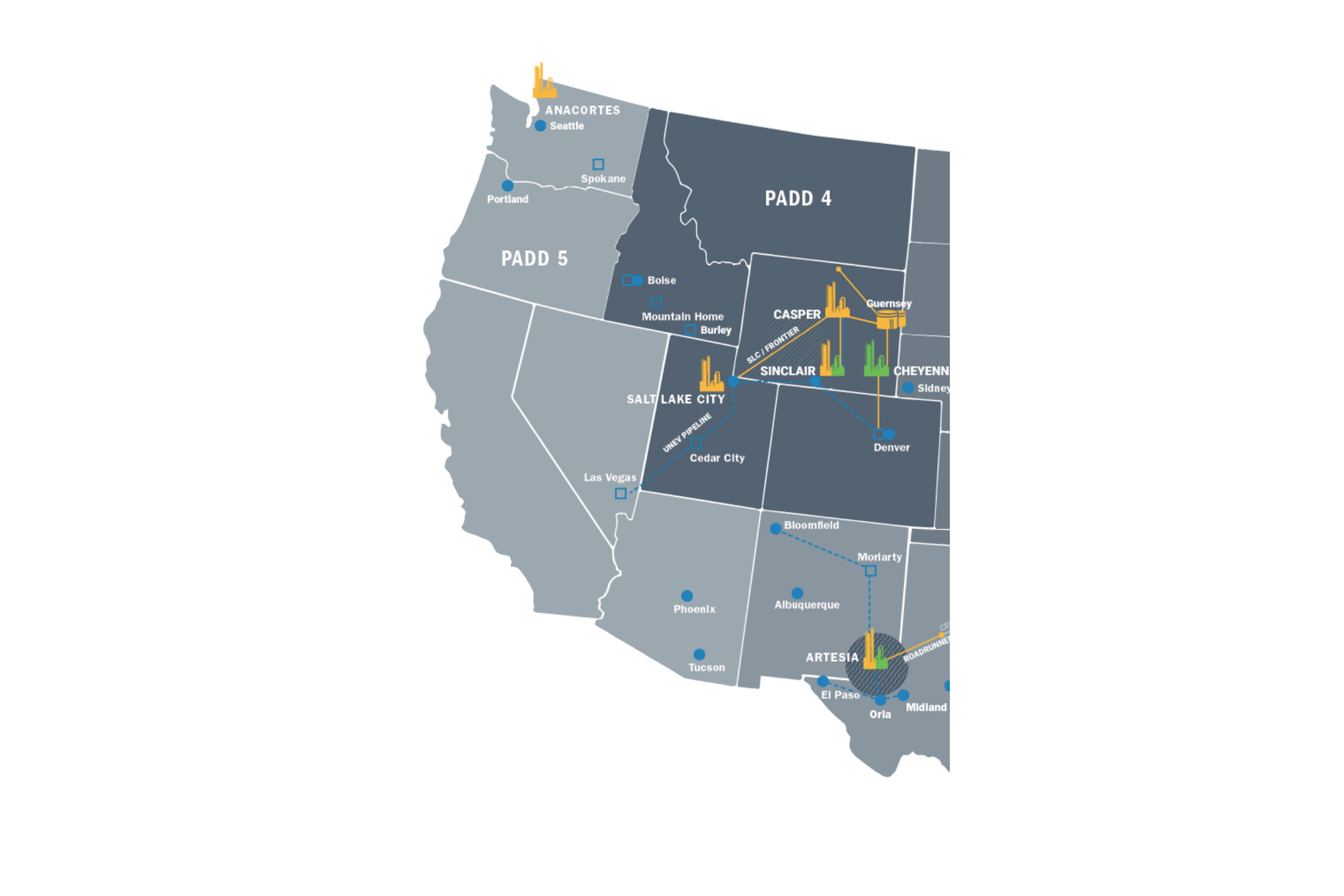
On Oct. 29, DINO announced that it is evaluating a multi-phased expansion of a refined products line from the Rocky Mountains (PADD 4) to the West Coast (PADD 5). The project will compete with a growing list of proposals to move more refined products to California, Arizona and Nevada, including the Sun Belt Connector from ONEOK (OKE) and the Western Gateway Pipeline planned by Phillips 66 (PSX) and Kinder Morgan (KMI).
The Sinclair expansion would add 150 Mb/d of capacity over two phases to California and Nevada refined products markets.

In Phase 1, DINO plans to expand the Pioneer Pipeline from Sinclair, WY to Salt Lake City, UT and streamline the UNEV Pipeline from Salt Lake City to Las Vegas, NV (see pipeline map from DINO). The expansion would add 35 Mb/d of capacity with a target online date in 2028.
Phase 2 is a more complex project that would add the remaining 115 Mb/d of capacity. DINO proposes to further expand the Pioneer and UNEV pipelines, and build a lateral from Salt Lake City to Reno, NV. Finally, the company would expand and reverse the Medicine Bow Pipeline running between Denver, CO and Sinclair.
The project leverages DINO’s refinery and pipeline assets in PADD 4 to transport more products west. In contrast, the Sun Belt Connector and Western Gateway proposals would pull products from refineries in Texas and the Midcontinent region. 
The Permian Basin at a Crossroads: Download Why This Pipeline Boom is Different
The Permian’s next big buildout is already taking shape — but this time, the drivers aren’t producers chasing oil. East Daley’s latest white paper reveals how gas demand from AI data centers, LNG exports, and utilities is rewriting the midstream playbook. Over 9 Bcf/d of new capacity and $12 billion in investments are reshaping flows, turning the Permian into a gas powerhouse even as rigs decline. Read Part II: Why This Pipeline Boom is Different
The three projects are competing to fill an expected supply shortfall in the West. California is steadily losing refining capacity as companies like PSX close refineries, curtailing volumes of gasoline, diesel and jet fuel that can be piped inland. At the same time, demand is increasing in Sun Belt states like Arizona and Nevada from economic growth and an influx of new residents.
If constructed, the Sinclair project will likely stimulate new demand for crude oil from the Denver-Julesburg, Uinta, Green River and Powder River basins, providing a broad-based lift to oil and gas operations in the Rockies. As competition heats up to move products west, DINO aims to capitalize on its existing pipeline infrastructure to meet the regional supply and demand imbalance.
Supply and Demand
The US natural gas pipeline sample, a proxy for change in oil production, decreased 0.9% W-o-W across all liquids-focused basins.
The Barnett sample in North Texas increased 22.5%, the Anadarko rose 2.4% and the Eagle Ford sample gained 4.7% W-o-W. These increases coincided with decreases in the other basins. The most notable decreases occurred from the Arkoma by 10.9%, Permian by 2.4%, Rockies by 3.0% and Williston by 3.8%. The Rockies and the Gulf of America have a high correlation between gas volumes and crude oil volumes, whereas the Permian and Eagle Ford basins correlation is less than 45%.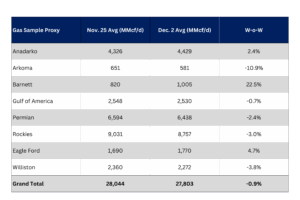
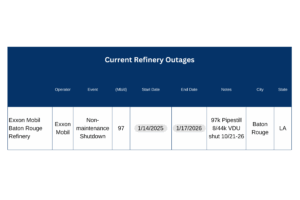
As of Dec. 8, there is no refining capacity offline for planned maintenance, as refinery outages reach a low. In January, a non-maintenance shutdown of 97 Mb/d is expected for half a week at ExxonMobil’s Baton Rouge refinery.
Vessel traffic monitored by EDA along the Gulf Coast decreased W-o-W. There were 23 vessels loaded for the week ending Dec. 6, coming down from a multi-month high the previous week.
Regulatory and Tariffs:
Presented by ARBO
Tariffs:
Gray Oak Pipeline, LLC: Certain available capacity discounts were increased.
Magellan Pipeline Company, L.P.: The tariffs were revised to add a new product and to update the product grade document to be consistent with ONEOK’s product grade documents.
The above information is provided by ARBO’s Oil Pipeline Tariff Monitor. For more information on regulatory proceedings or tariff rates, please contact please contact Corey Brill via email at [email protected] or phone at 202-505-5296. https://www.goarbo.com/