



Executive Summary:
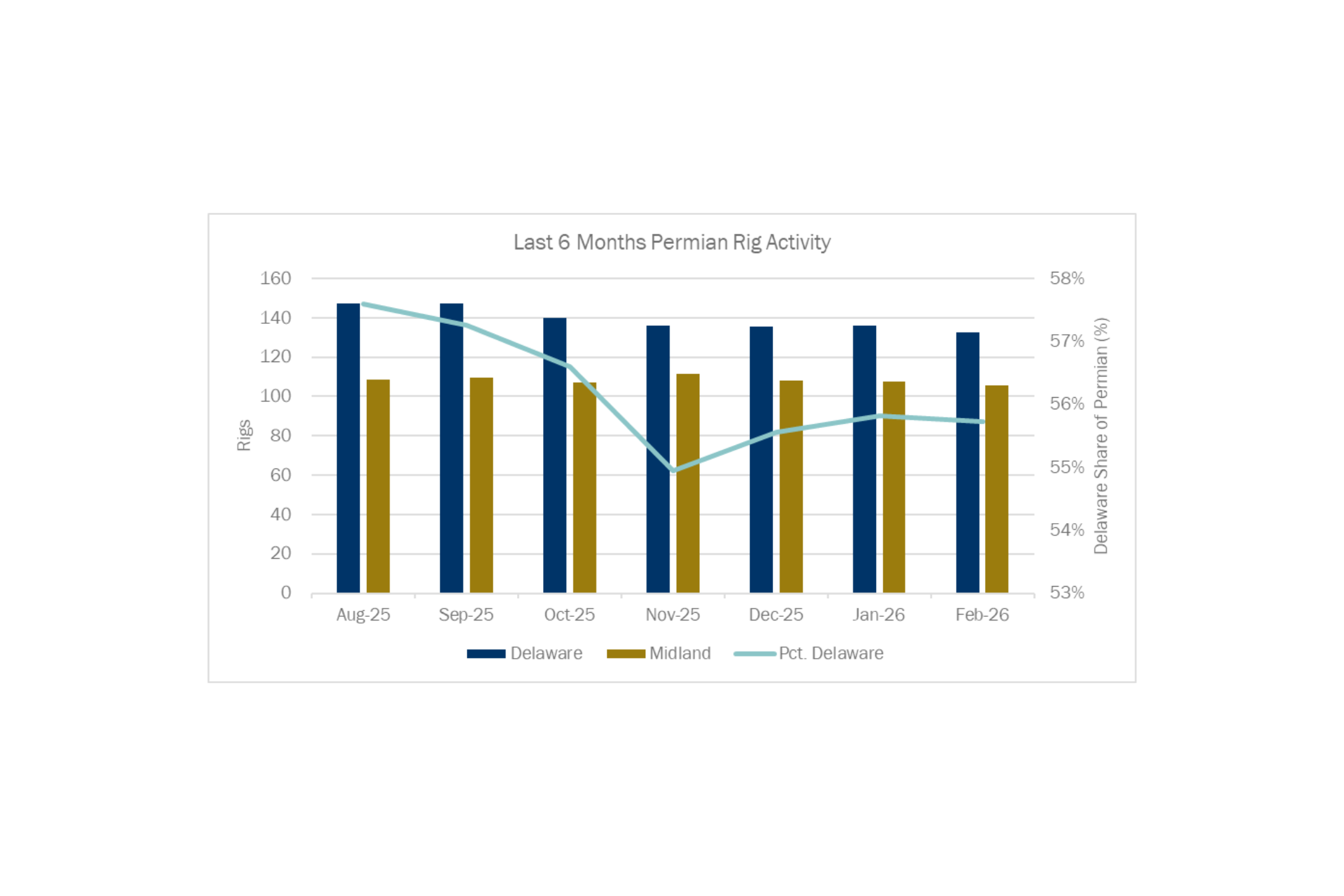
Rigs: The total US rig count decreased during the week of Feb. 28 from 525 to 521
Infrastructure: ExxonMobil will lead the way in an otherwise modest outlook for Permian supply growth in 2026, according to East Daley’s survey of basin producers.
Supply & Demand: The US natural gas pipeline sample, a proxy for change in oil production, decreased -0.2% W-o-W across all liquids-focused basins.
Rigs:
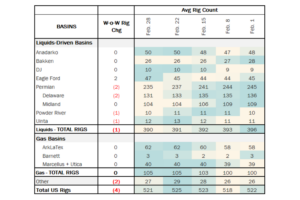
The total US rig count decreased during the week of Feb. 28 from 525 to 521. Liquids-driven basins decreased W-o-W from 391 to 390.
- Eagle Ford (+2): Chevron
- Permian
- Delaware (-2): Coterra Energy
- Powder River: (-1): EOG Resources
- Uinta (-1): Uinta Wax Operating
Infrastructure:
With 4Q25 earnings wrapped up, East Daley Analytics’ survey of Permian producer guidance reveals two distinct camps: ExxonMobil (XOM), and the rest of the upstream. Exxon is prepared to carry the industry’s water amid an otherwise modest outlook for supply growth in 2026.
Our survey of 14 public operators in the Permian Basin points to 2.7% growth in oil production in 2026, or ~183 Mb/d (see table). Of the 14 companies, half expect flat output this year.
Exxon is the clear outlier. The major guided to 12.5% production growth in the Permian in 2026, or ~113 Mb/d. XOM accounts for over half of the supply gains producers anticipate in the basin. Excluding Exxon, Permian guidance would decline to 1.2% growth this year.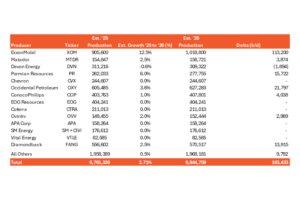
The only other producer calling for relatively robust growth in 2026 is Permian Resources (PR) at 6.0%. Occidental (OXY), the second-largest Permian oil producer after XOM, has guided to 3.6% growth.
Only Devon Energy (DVN) is predicting a dip (-0.6%) in its oil production in 2026. DVN is consolidating its $58B merger with Coterra Energy (CTRA), and the combined company will provide full-year guidance once the merger closes, expected in 2Q26.
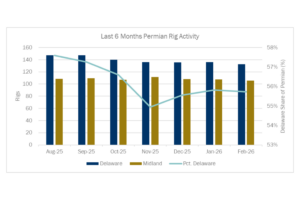
The modest Permian growth guidance comes as no surprise given lower WTI prices and declining rig counts through most of 2025. A total of 240 rigs are currently drilling in the Permian Basin, down 57 from a recent peak of 297 rigs in April ’25 (see figure from Energy Data Studio). That month brought “Liberation Day,” the start of President Trump’s sweeping tariffs on global trading partners, which sank oil prices from around $80/bbl to under $60 by the end of the year.
WTI prices rebounded sharply last week due to onset of the war with Iran, settling at $90.90/bbl on Friday. Despite the heady gains, East Daley does not anticipate any major upward revisions to producer guidance for the balance of 2026.
We believe most operators would be averse to changing course so soon after setting expectations with investors. Moreover, the binding constraint in the Permian is associated gas takeaway; several producers called out on their earnings calls that growth depends on the start of new gas pipelines, including the Blackcomb and Hugh Brinson projects, which won’t start until 4Q26. Instead, we see higher prices linked to uncertainty in the Middle East as an opportunity for producers to hedge and shore up balance sheets.
Supply and Demand
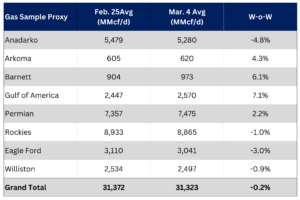
The US natural gas pipeline sample, a proxy for change in oil production, decreased -0.2% W-o-W across all liquids-focused basins.
Volumes showed mixed W-o-W movement across basins. The Arkoma (+4.3%), Barnett (+6.1%), Gulf of America (+7.1%) and Permian (+2.2%) all increased W-o-W. The Anadarko Basin sample decreased 4.8% following an increase last week. The Rockies decreased 1%, Eagle Ford decreased 3%, and the Williston Basin held relatively flat with a decrease of 0.9%. Basin-level movements largely offset one another, leaving overall volumes relatively steady. The Rockies and the Gulf of America have a high correlation between gas volumes and crude oil volumes, whereas the Permian and Eagle Ford basins correlation is less than 45%.
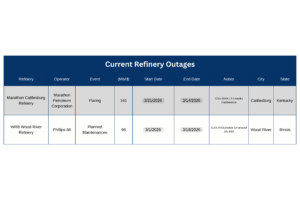
As of March 11, ~259 Mb/d of refining capacity is offline for maintenance. Marathon’s Cattlesburg refinery is experiencing flaring and has ~161 Mb/d of capacity offline, while Phillips 66’s Wood River refinery is undergoing planned maintenance.
Vessel traffic monitored by EDA along the Gulf Coast remained steady W-o-W. A total of 25 vessels were loaded for the week ending March 7, a slight decrease from the increases seen the past two weeks.
Presented by ARBO
Tariffs:
Gray Oak Pipeline, LLC: Certain available capacity discounts were increased.
Magellan Pipeline Company, L.P.: The tariffs were revised to add a new product and to update the product grade document to be consistent with ONEOK’s product grade documents.
The above information is provided by ARBO’s Oil Pipeline Tariff Monitor. For more information on regulatory proceedings or tariff rates, please contact please contact Corey Brill via email at [email protected] or phone at 202-505-5296. https://www.goarbo.com/