



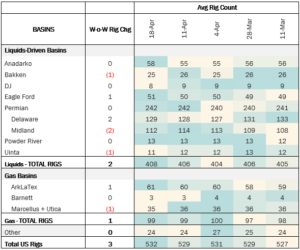
Rigs: The total US rig count increased to 532 the week of April 18.
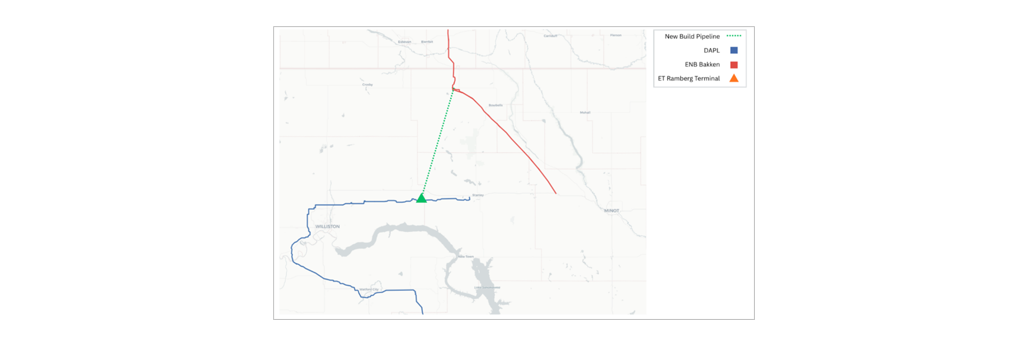
Infrastructure: A plan by Enbridge and Energy Transfer to move Canadian crude oil through the Bakken has cleared a key hurdle, receiving a presidential permit on April 15 to reverse flows on ENB’s Bakken Pipeline.
Supply & Demand: The US natural gas pipeline sample, a proxy for change in oil production, decreased 0.1% for the April 17 week across all liquids-focused basins.
Rigs:
The total US rig count increased during the week of April 18 to 532 rigs, up 3 from the prior week. Liquids-driven basins increased W-o-W to 408 from 406.
- Anadarko (+3): Mewbourne Oil
- Bakken (-1): Kraken Resources
- Eagle Ford (+1): Espada Energy
- Permian
- Delaware (+2): ConocoPhillips
- Midland (-2): Vital Energy
Infrastructure:
A plan by Enbridge (ENB) and Energy Transfer (ET) to move Canadian crude oil through the Bakken has cleared a key hurdle, receiving a presidential permit on April 15 to reverse flows on ENB’s Bakken Pipeline.
The permit authorizes continued operation of the cross-border Bakken system, as well as the construction of a new Line 26 segment. The Line 26 Optimization project involves reversing the Bakken line, which currently flows northbound into Canada.
East Daley Analytics highlighted the joint ENB-ET project in December when details were scant. Enbridge plans to construct a new 24-inch pipeline connecting the Bakken system to ET’s Ramberg Terminal, providing direct access to Dakota Access Pipeline (DAPL). The new pipe is expected to span ~80 miles, of which 60 miles will be built in North Dakota (see project map).
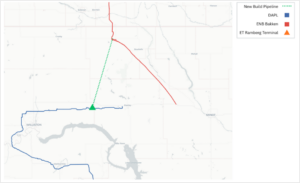
As part of the project, the existing 12-inch line will be decommissioned from Steelman Station to just south of the US– Canada border, with the remaining segment to the Berthold Terminal abandoned. The new pipeline will generally parallel the existing route before diverging at a new US valve site and tying into Ramberg. We expect the line to primarily transport conventional light crude.
While Enbridge previously guided to filing applications in the second half of 2026, the presidential permit indicates an accelerated timeline. Construction is expected to start in 2027, and ENB is targeting in-service in late 2028, pending state and local approvals.
The Enbridge Bakken system has a capacity of 149 Mb/d but its throughput averaged only 25 Mb/d in 2025, according to East Daley’s Crude Hub Model, indicating significant underutilization. DAPL’s flows averaged 515 Mb/d in 4Q25; volumes declined to 492 Mb/d in January ‘26. With 750 Mb/d of capacity, DAPL has ample capacity to absorb incremental southbound barrels as Western Canadian production and exports increase
Supply & Demand:
The US natural gas pipeline sample, a proxy for change in oil production, decreased 0.1% for the April 17 week across all liquids-focused basins.
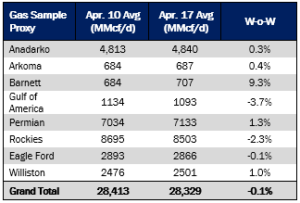 Volumes showed mixed increases and decreases, with the Barnett and Permian basins seeing the most significant upticks of 9.3% and 1.3%, respectively. The Anadarko (+0.3%), Arkoma (+0.4%), and Willison (+1.0%) all saw slight increases. The Gulf of America (-3.7%), Rockies (-2.3%) and Eagle Ford (-0.1%) decreased W-o-W. Basin-level movements largely offset one another, leaving overall volumes relatively steady. The Rockies and the Gulf of America have a high correlation between gas volumes and crude oil volumes, whereas the Permian and Eagle Ford basins correlation is less than 45%.
As of April 28, 150.5 Mb/d of refining capacity is offline for maintenance. BP’s Whiting refinery has 75 Mb/d of capacity offline, while the Par Montana refinery in Billings, MT contributed 61.5 Mb/d of capacity down for scheduled maintenance. Both are scheduled to be back up and running the second week of May.
Vessel traffic monitored by East Daley Analytics along the Gulf Coast decreased W-o-W. A total of 34 vessels were loaded for the week ending April 25, a sizeable increase from the beginning of the month.