



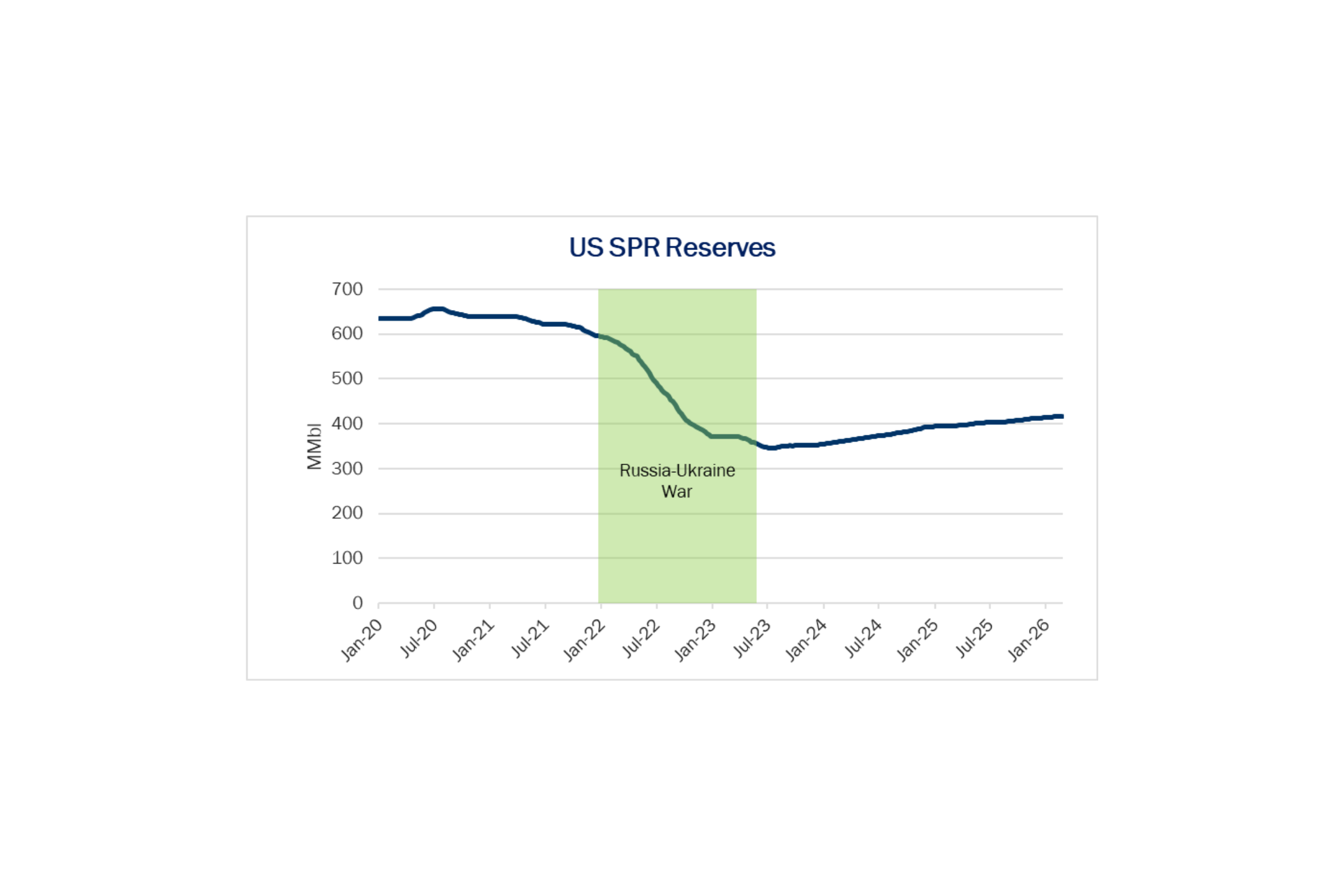
Rigs: The total US rig count decreased during the week of March 7 from 521 to 520
Infrastructure: The International Energy Agency (IEA) on Thursday announced member countries would release 400 MMbbl of oil in storage to address shortages from the Iran war, the largest release ever recorded.
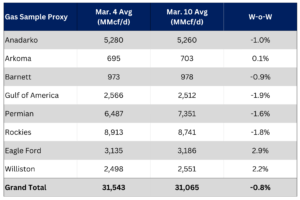
Supply & Demand: The US natural gas pipeline sample, a proxy for change in oil production, decreased 0.8% W-o-W across all liquids-focused basins.
Rigs:
The total US rig count decreased during the week of March 7 from 521 to 520. Liquids-driven basins increased W-o-W from 392 to 393
- Anadarko (+1): Mewbourne Oil
- DJ (-1): Overland Resources
- Eagle Ford (+1): Chevron Corporation
- Permian:
- Delaware (-1): Permian Resources, LLC
- Midland (+1): Summit Petroleum Corporation
Infrastructure:
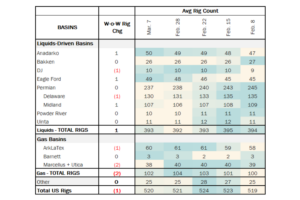
The International Energy Agency (IEA) on Thursday announced member countries would release 400 MMbbl of oil in storage to address shortages from the Iran war, the largest release ever recorded.
The US, one of 32 IEA member countries, will release 172 MMbbl from the Strategic Petroleum Reserve (SPR), or 43% of the total.
The IEA’s last major release of barrels was in 2022, when members released slightly over 180 MMbbl during the Russia invasion of Ukraine.
The US SPR includes four storage fields across the Gulf Coast with capacity of ~714 MMbbl: Bryan Mound and Big Hill in Texas, and West Hackberry and Bayou Choctaw in Louisiana. Currently, SPR inventory totals 415 MMbbl of crude.
East Daley’s Crude Hub Model shows flows on the pipelines that move oil into the SPR. These include Seaway Pipeline, a 50/50 JV between Enbridge (ENB) and Enterprise Products (EPD); Capline, owned by Plains All American (PAA), Marathon and BP; and the Texoma system. Shell’s (SEL) Zydeco Pipeline in southeastern Louisiana also connects into Capline.
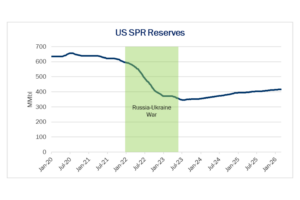
The process of filling and withdrawing from the SPR is slow. According to the DOE, Bayou Choctaw has a fill rate of 110 Mb/d, and the other three can inject 225 Mb/d. As for withdrawals, the DOE states the maximum drawdown rate is 4.4 MMb/d.
The release will deplete SPR inventory oil to 243 MMbbl once completed, leaving SPR storage levels at the lowest in over 40 years.
The coordinated global storage release will only backfill for a short period the ~20 MMb/d that flow through the Strait of Hormuz. The 400 MMbbl would cover a 20-day supply gap, assuming all flows ceased through the strait.
In the short run, releasing the oil is bearish for prices. But after the barrels are used up, a depleted SPR becomes bullish if the conflict does not end soon. In the long term, the SPR will need to be refilled, which will benefit pipeline owners.
Supply and Demand
The US natural gas pipeline sample, a proxy for change in oil production, decreased 0.8% W-o-W across all liquids-focused basins. Volumes showed a majority decrease, with Eagle Ford and Willison basins seeing an increase of 2.9% and 2.2%, respectively. The Anadarko, Barnett, Permian, and Rockies all saw decrease in volumes (-1%, -0.9%, -1.6%, -1.8%), with the largest decrease being in the Gulf of America with -1.9% decline W-o-W. Basin-level movements largely offset one another, leaving overall volumes relatively steady. The Rockies and the Gulf of America have a high correlation between gas volumes and crude oil volumes, whereas the Permian and Eagle Ford basins correlation is less than 45%.
As of March 18, ~90 Mb/d of refining capacity is offline for maintenance. Phillips 66’s Wood River Refinery is undergoing planned maintenance, which started on March 1.
Vessel traffic monitored by EDA along the Gulf Coast remained steady W-o-W. A total of 32 vessels were loaded for the week ending March 14, a large increase from the previous week.