



Executive Summary:
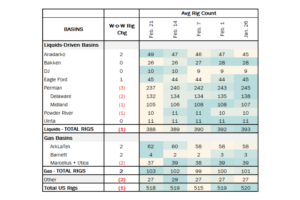
Rigs: The total US rig count decreased during the week of Feb. 21 from 519 to 518.
Infrastructure: True Companies’ Bridger Pipeline is developing a pipeline to move Western Canadian crude directly to the Guernsey hub, potentially using parts of the developed Keystone XL on Canada’s side of the border.
Supply & Demand: The US natural gas pipeline sample, a proxy for change in oil production, decreased -2.2% W-o-W across all liquids-focused basins.
Rigs:
The total US rig count decreased during the week of Feb. 21 from 519 to 518. Liquids-driven basins decreased W-o-W from 389 to 388.
- Anadarko (+2): Territory Resources
- Eagle Ford (+1): Kilam Oil
- Permian (-3)
- Delaware (-2): ExxonMobil
- Midland (-1): Double Eagle
- Powder River (-1): EOG Resources
Infrastructure:
Bridger Pipeline, a True Companies affiliate, is developing a crude oil pipeline to move Western Canadian crude directly to the Guernsey hub, potentially using parts of the partially developed Keystone XL on Canada’s side of the border. The central issue is not the border segment — it is whether Guernsey can handle the increased barrels.
Bridger filed with the Montana Department of Environmental Quality for a 550 Mb/d, 36-inch crude oil pipeline from Phillips County, MT to Guernsey, WY. Bridger is targeting a July 2027 construction start.
At 550 Mb/d, Guernsey cannot absorb the volume without new downstream capacity, according to the Crude Hub Model. The Guernsey hub primarily aggregates and redistributes Bakken and Powder River production through regional refineries and pipelines. Shippers will need more downstream takeaway to transport the additional Bridger barrels to the Gulf Coast, where refineries are better equipped to process heavy Canadian crude.
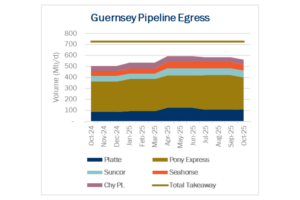
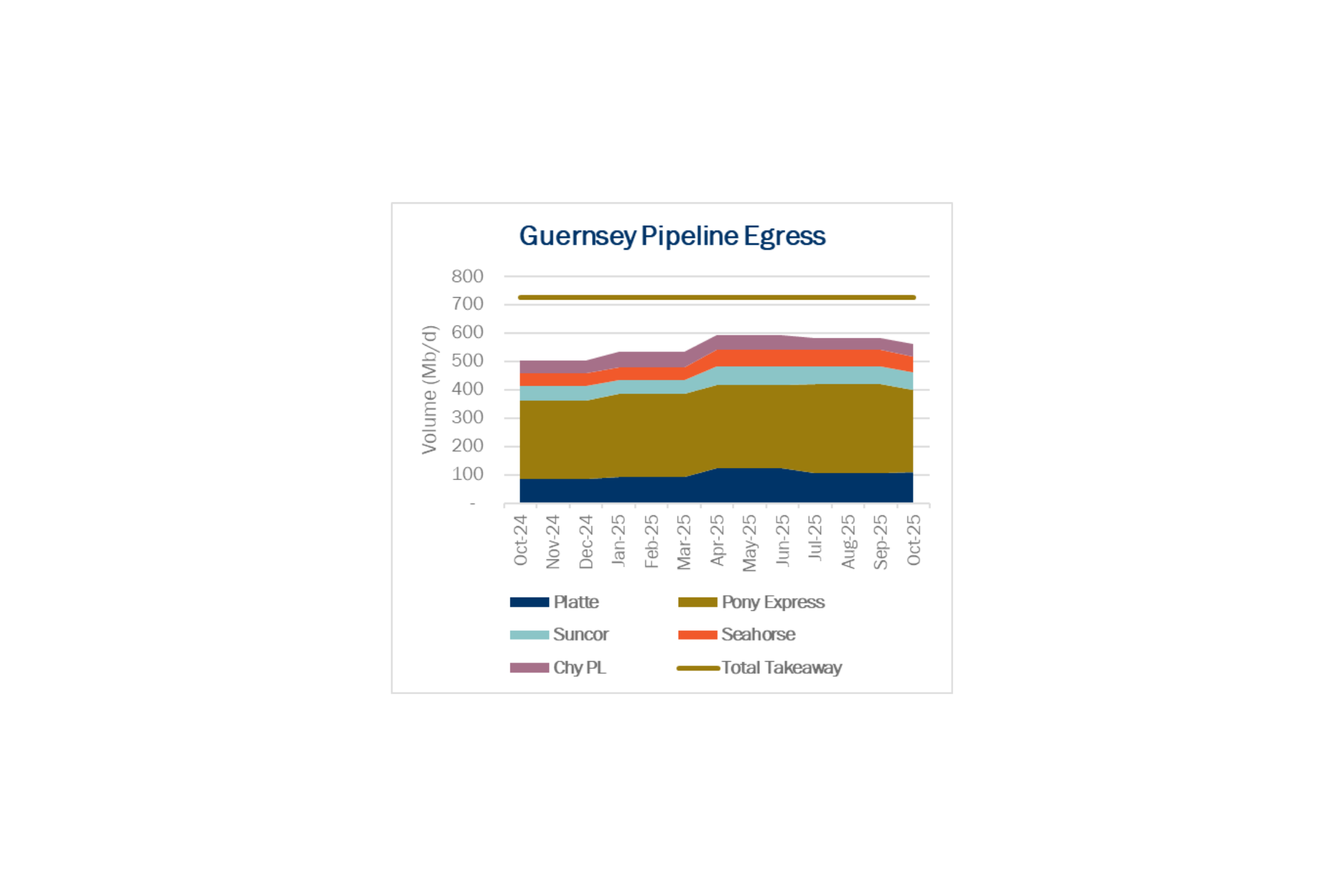
While the project does not outline how volumes would move beyond Guernsey, East Daley sees a likely pathway to address the constraint. The solution would be to twin Tallgrass’ Pony Express Pipeline, currently the premier route for moving crude from Guernsey to the Gulf Coast. Pony is already operating above its 300 Mb/d nameplate capacity out of Guernsey, according to the Crude Hub Model, averaging ~312 Mb/d in 3Q25.
Tallgrass and True Companies last Tuesday (Feb. 24) announced a joint open season for Bridger and Pony Express, as well as Bridger and Seahorse. Bridger already has joint tariff agreements in place with both Pony and Seahorse, so that tariff structure is not new. East Daley believes the open season is intended to secure commitments on Pony Express, in order to provide the commercial backing to justify twinning the pipeline. Tallgrass wants confirmation that Pony will remain fully utilized before committing capital to expand the system.


At the same time, Bridger is evaluating how many Bakken barrels would remain committed if its system is expanded. East Daley believes looping Pony Express is the most likely solution to address Guernsey’s takeaway constraints.
The proposed Bridger expansion comes at a pivotal time, as both Enbridge (ENB) and Energy Transfer (ET) are targeting mid-2026 to finalize their plan to backfill DAPL with Canadian crude. We are currently assessing the likelihood that both projects could move forward vs a scenario where only one ultimately advances. At this stage, Bridger appears intent on positioning to capture Western Canadian volumes.
Supply and Demand
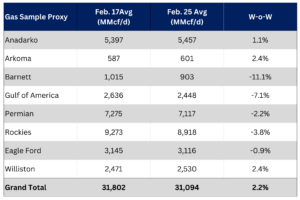
The US natural gas pipeline sample, a proxy for change in oil production, decreased -2.2% W-o-W across all liquids-focused basins.
On a basin level, the Anadarko (+1.1%), Arkoma (+2.4%) and Williston (+2.4%) increased W-o-W. The Barnett decreased 11.1% following an increase last week, and the Gulf of America (-7.1%), Permian (-2.2%) and Rockies (-3.8%) also declined W-o-W. The Eagle Ford remained relatively flat.
Production remains below early February levels despite mixed basin-level recovery trends. The Rockies and the Gulf of America have a high correlation between gas volumes and crude oil volumes, whereas the Permian and Eagle Ford basins correlation is less than 45%.
As of March 4, there are no active refinery outages.
Vessel traffic monitored by East Daley along the Gulf Coast remained steady W-o-W. A total of 27 vessels were loaded for the week ending Feb. 28, continuing with the increasing trend seen in the past three weeks.
Presented by ARBO
Tariffs:
Gray Oak Pipeline, LLC: Certain available capacity discounts were increased.
Magellan Pipeline Company, L.P.: The tariffs were revised to add a new product and to update the product grade document to be consistent with ONEOK’s product grade documents.
The above information is provided by ARBO’s Oil Pipeline Tariff Monitor. For more information on regulatory proceedings or tariff rates, please contact please contact Corey Brill via email at [email protected] or phone at 202-505-5296. https://www.goarbo.com/