


Rigs:
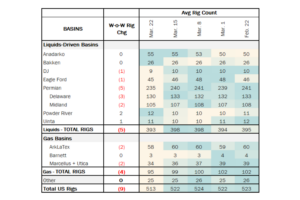
The total US rig count decreased during the week of March 22 from 522 to 513.
Infrastructure: Oil market volatility from the Iran conflict could pump up earnings for South Bow.
Supply & Demand: The US natural gas pipeline sample, a proxy for change in oil production, decreased 0.7% W-o-W across all liquids-focused basins.
Rigs:
The total US rig count decreased during the week of March 22 from 522 to 513. Liquids-driven basins decreased W-o-W from 398 to 393.
- DJ (-1): Occidental Petroleum
- Eagle Ford (-1): Home Petroleum
- Permian
- Delaware (-3): BP
- Midland (-2): Diamondback Energy
- Powder River (+2): 1876 Resources LLC
- Uinta (+1): Finley Resources
Infrastructure:
Oil market volatility from the Iran conflict could pump up earnings for South Bow (SOBO). The company’s marketing segment has been pressured in recent quarters by reduced volumes on Keystone Pipeline, but is poised to gain from widening price spreads to the Gulf Coast.
Keystone has been operating under pressure restrictions since April ’25, when the pipeline suffered a rupture in North Dakota. The restrictions have constrained throughput from Western Canada and limited the system’s ability to move barrels beyond committed volumes. As a result, South Bow has primarily focused on meeting contractual obligations, reducing its exposure to higher-margin spot opportunities and weighing on overall marketing performance.
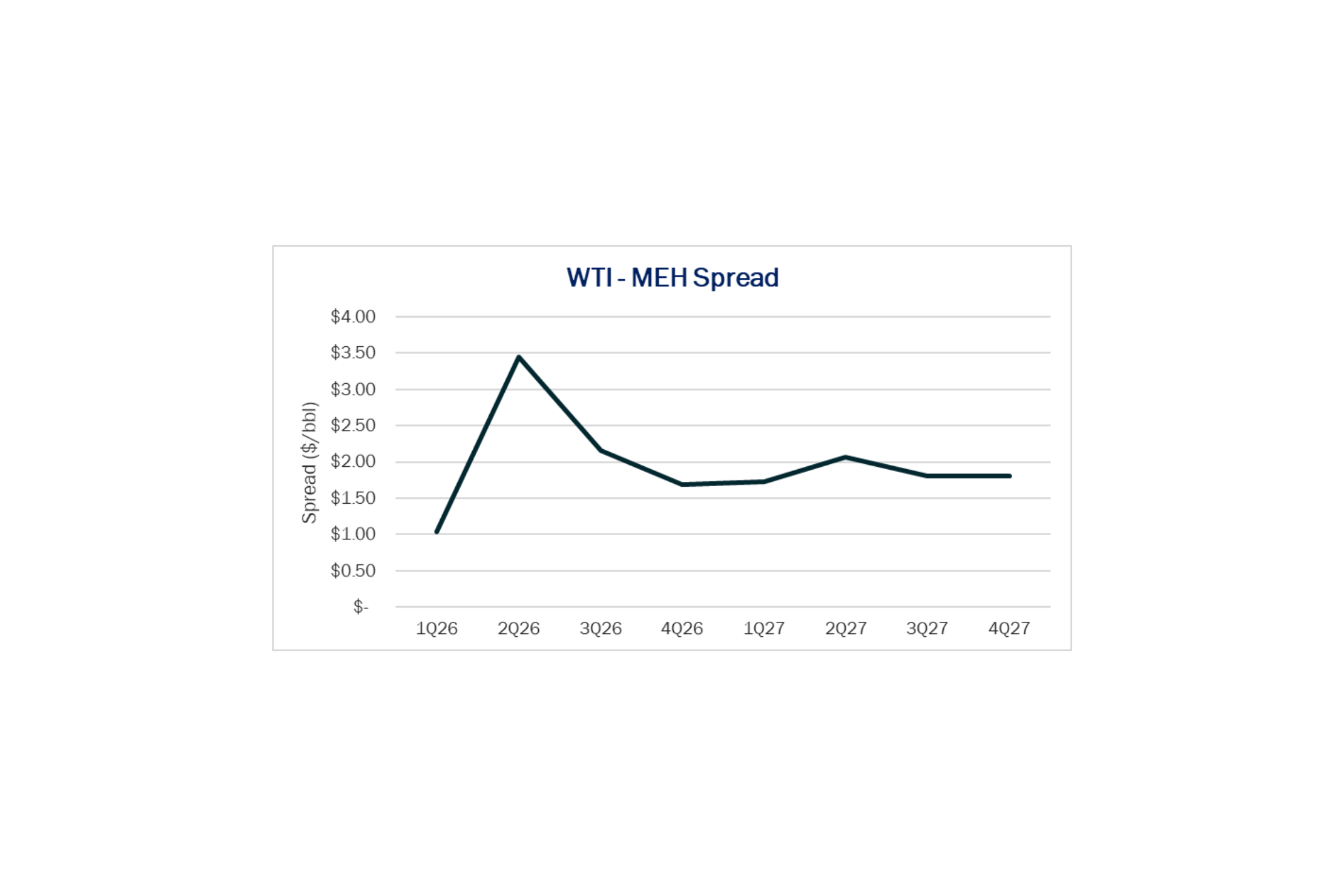
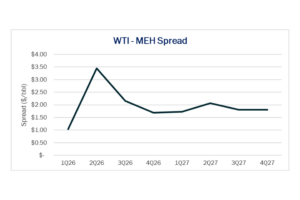
That backdrop may now be shifting. Spreads have widened between WTI and Magellan East Houston (MEH), a primary benchmark for Gulf Coast crude exports. The wider differentials create a more constructive environment for earnings by increasing the value of access to Gulf Coast markets (see figure).
Under normal conditions, the WTI-MEH spread reflects the marginal cost of transporting crude from the Cushing hub in Oklahoma to Houston, averaging about $1.02/bbl in 2025. However, netbacks to the Gulf Coast have strengthened since the start of the Iran war, a result of increased refinery demand and higher export pricing tied to the international Brent benchmark. Global supply disruptions have tightened waterborne crude markets and pulled US barrels toward the coast, pushing the spread above $4 in April.
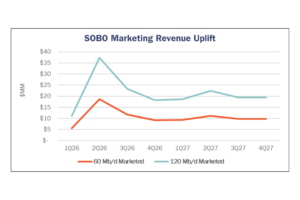
While the marketing segment is somewhat opaque, East Daley’s SOBO Financial Blueprint provides insight into the potential upside. South Bow’s Cushing-to-Gulf Coast corridor is well positioned to capture this opportunity, with ~120 Mb/d of open capacity available to its marketing arm.
We estimate Keystone’s leg from Cushing to the Gulf Coast could generate $80MM in additional revenue from 2Q26 to YE26 and $80MM in 2027 if all 120 Mb/d of open capacity were utilized (see figure). While the pressure restrictions on Keystone have curtailed imports from Canada, they do not apply to the southern leg of the system.
EDA views recent volatility as a near-term tailwind that could help South Bow optimize its assets and strengthen its balance sheet.
Supply and Demand
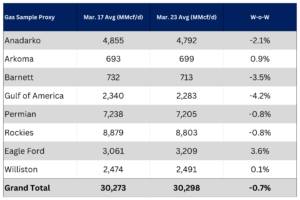
The US natural gas pipeline sample, a proxy for change in oil production, decreased 0.7% W-o-W across all liquids-focused basins.
Volumes increased in the Arkoma (+0.9%), Eagle Ford (+3.6%) and Williston (+0.1%) basins. The Permian and Rockies saw slight decreases, both down 0.8%, whereas the Anadarko (-2.1%), Barnett (-3.5%) and Gulf of America (-4.1%) saw larger declines W-o-W. The Rockies and the Gulf of America have a high correlation between gas volumes and crude oil volumes, whereas the Permian and Eagle Ford basins correlation is less than 45%.
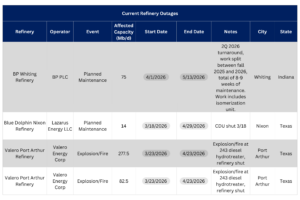
As of March 31, ~449 Mb/d of refining capacity is offline for maintenance. The majority of this outage is attributable to the Valero Port Arthur refinery, where 360 Mb/d remains offline through April 23 following an explosion at its 243 Mb/d diesel hydrotreater.
Vessel traffic monitored by East Daley along the Gulf Coast decreased W-o-W. A total of 29 vessels were loaded for the week ending March 28, a slight increase.