



Rigs:
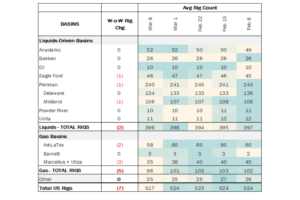
The total US rig count decreased during the week of March 8 from 524 to 517.
Infrastructure: In a sustained $100/bbl oil scenario, stronger Permian production and export demand are likely to outpace available pipeline capacity, tightening egress and driving wider differentials beyond what the market currently expects.
Supply & Demand: The US natural gas pipeline sample, a proxy for change in oil production, decreased 1.4% W-o-W across all liquids-focused basins.
Rigs:
The total US rig count decreased during the week of March 8 from 521 to 520. Liquids-driven basins increased W-o-W from 398 to 396
- Eagle Ford (-1): BP
- Permian:
- Midland (-1): Double Eagle
Infrastructure:
Just one month ago, Permian producers outlined 2026 production guidance to little market reaction, signaling low-to-moderate growth despite a forward curve near $65/bbl and declining to ~$61 by 2027. That outlook implied roughly 2% production growth from 2025 to 2026, reinforcing expectations of continued capital discipline.
In early March, Operation Epic Fury disrupted that narrative. Prompt WTI prices surged above $90/bbl, though the forward curve remained steeply backwardated, reflecting market expectations that the conflict would be short-lived. As of March 6, the 2027 average WTI price was only modestly higher than pre-conflict levels, indicating limited reassessment of long-term supply risk.
That view has since shifted.
Escalating strikes and counterstrikes – most notably Iran’s targeting of critical oil and gas infrastructure, including Qatar’s Ras Laffan industrial complex – have materially altered the global supply outlook. Disruptions to LNG and liquids infrastructure increase the likelihood of sustained tightness in global energy markets, supporting a higher-for-longer price environment.
As of March 18, WTI Cushing contracts average ~$72/bbl in 2027. East Daley Analytics believes a sustained prompt price near $100, supported by a forward curve above $70, would meaningfully change producer behavior while also reinforcing global demand for US crude exports.
Permian Supply Response Under $100 Oil
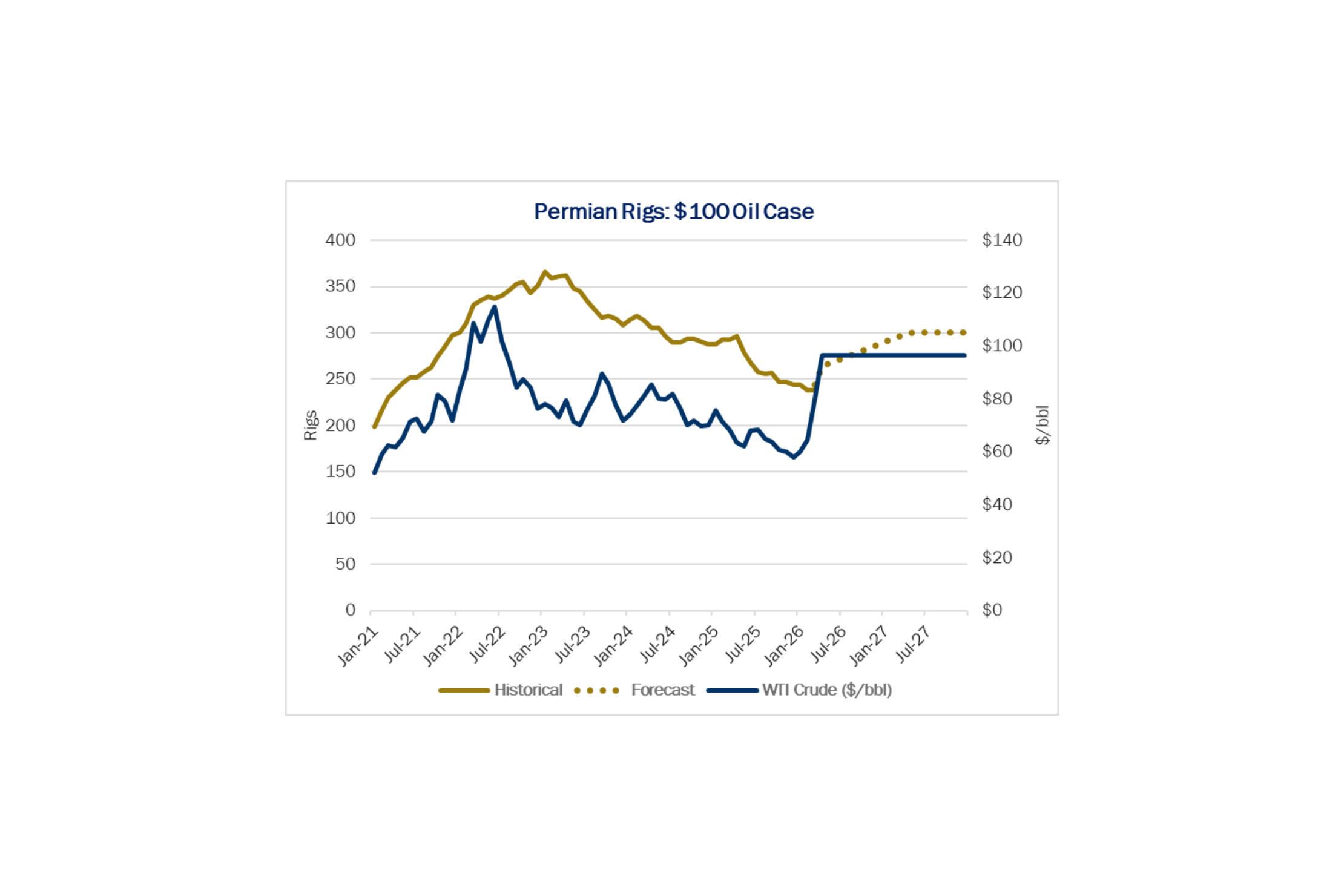
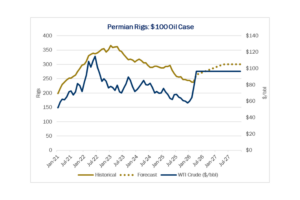
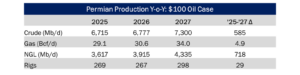
In a prolonged $100/bbl oil scenario, East Daley expects Permian producers to increase rig activity from ~241 rigs today to ~300 rigs by YE27.
While this response would be more muted than in prior $100 price environments – reflecting continued emphasis on capital discipline, free cash flow generation and inventory management – it still represents a meaningful acceleration in activity.
As a result, Permian crude production reaches ~7.3 MMb/d by 2027 in the Crude Hub Model, compared to our base case of ~6.8 MMb/d. This implies an incremental ~500 Mb/d of supply on average in 2027.
At the same time, global pricing dynamics are increasing the pull on US crude.
A widening Brent–WTI spread strengthens export incentives by improving the competitiveness of US barrels in international markets. As Brent trades at a premium, Gulf Coast exports become more attractive, supporting higher outbound volumes.
This premium is likely to remain elevated as geopolitical tensions persist, reinforcing export demand for Permian crude. In this environment, incremental supply is not only driven by higher flat prices but also by stronger global demand signals.
Egress Constraints Limit the Pace of Growth
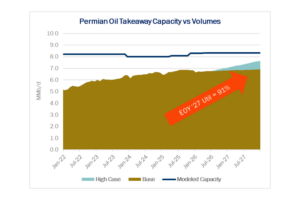
The combination of rising supply and stronger export demand is converging on a network already operating near capacity, as shown in the Crude Hub Model. Permian takeaway capacity to the Gulf Coast is highly utilized across both major corridors:
- Corpus Christi, the primary export outlet, remains the most efficient pathway for waterborne crude flows. Key pipelines such as Cactus II are already operating above nameplate capacity, while Gray Oak and Cactus III are approaching full utilization.
- Houston-bound pipelines also face tight system constraints. Systems including Longhorn, West Texas Gulf, Permian Express, and Midland-to-ECHO are at or near operational limits.
Cushing provides a secondary outlet, but is less directly tied to export flows and would likely fill only after Gulf Coast pathways are maximized. 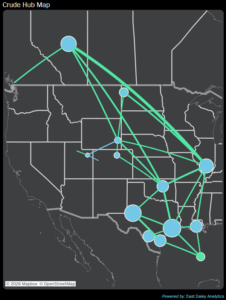
In contrast, export dock capacity is not the limiting factor. Gulf Coast terminals have substantial available capacity, with Corpus Christi and Houston operating well below maximum throughput levels. Facilities such as Ingleside Energy Center, Gibson, and major Houston-area docks retain the ability to absorb additional volumes.
As a result, the binding constraint on incremental export growth is not terminal capacity, but upstream pipeline takeaway.
The tightening in pipeline egress capacity has two key implications for crude markets:
1) Wider Midland-to-MEH Spreads
Higher production volumes combined with stronger export demand will increase pipeline utilization from the Permian to the Gulf Coast, driving wider Midland-to-MEH differentials than currently implied by the market. This creates incremental marketing and transportation upside for key operators, including Plains All American (PAA), Enterprise Products (EPD) and Enbridge (ENB).
2) Increased Likelihood of Pipeline Expansions
New oil pipeline expansions are more likely with sustained higher oil prices. Several projects have started in the last year, including a Gray Oak expansion (+120 Mb/d) and a Midland-to-ECHO expansion (+200–210 Mb/d). A potential expansion of Cactus III (+300 Mb/d) has been discussed and becomes more probable if oil prices stay near $100.
Bottom Line: The market initially treated geopolitical disruption as a short-term price shock. However, recent escalation points to a more durable shift in global supply-demand dynamics. In a sustained $100/bbl oil environment, higher Permian production and stronger export demand act in tandem, pushing additional volumes onto an already constrained takeaway system. This convergence tightens crude egress, widens basin differentials, and increases the likelihood of new midstream investments.
Supply and Demand
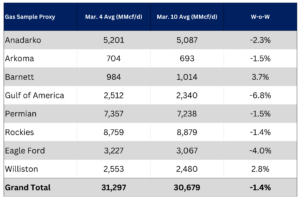
The US natural gas pipeline sample, a proxy for change in oil production, decreased 1.4% W-o-W across all liquids-focused basins.
Volumes declined in most basins, with the Barnett and Rockies basins increasing 3.7% and 1.4%, respectively. The Anadarko (-2.3%), Permian (-1.5%), Eagle Ford (-4%) and Bakken (-2.8%) all saw decreased volumes. The largest decrease occurred in the Gulf of America, down 6.8% W-o-W. Basin-level movements largely offset one another, leaving overall volumes relatively steady. The Rockies and the Gulf of America have a high correlation between gas volumes and crude oil volumes, whereas the Permian and Eagle Ford basins correlation is less than 45%.
As of March 24, ~285 Mb/d of refining capacity is offline for maintenance. Not reflected in the graph, Valero’s Port Arthur refinery shut in ~380 Mb/d of refining capacity following an explosion on March 23 in its diesel hydrotreater unit. The company has not yet disclosed the extent of the damage or provided a timeline for restarting operations.
Vessel traffic monitored by East Daley along the Gulf Coast decreased W-o-W. A total of 26 vessels were loaded for the week ending March 21, a sizeable decrease from the previous week.