



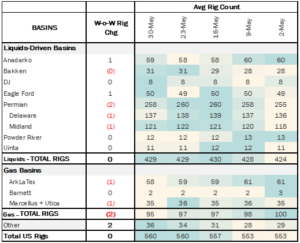
Rigs: The total US rig count was unchanged at 560 rigs for the week of May 30.
Infrastructure: East Daley expects private operators to drive most of the gains in crude oil production in response to higher WTI prices. Our thesis is seeing early validation in the Permian Basin, where private E&Ps lifted drilling in May.
Supply & Demand: The US natural gas pipeline sample, a proxy for change in oil production, decreased 1.6% W-o-W across all liquids-focused basins for the week ending June 8.
Rigs:
The total US rig count was unchanged at 560 rigs for the week of May 30. Liquids-driven basins remained at 429 rigs W-o-W.
- Anadarko (+1): Flywheel Energy
- Permian
- Delaware (-1): Continental Resources
- Midland (-1): Firebird Energy II
- Eagle Ford (-1): GeoSouthern Energy
Infrastructure:
East Daley Analytics expects private operators to drive most of the gains in US crude oil production in response to higher WTI prices. Our thesis is seeing early validation in the Permian Basin, where private E&Ps have sown the first seeds of a sustained recovery.
Permian producers boosted drilling in May, pushing the basin rig count to 255 mid-month vs 244 rigs at the end of March. At 255 rigs, the Permian rig count is the highest since September 2025, according to East Daley’s Energy Data Studio. Privately owned producers have accounted for nearly all the recent gains.
In late March, East Daley revised up our oil and gas supply outlook after WTI prices jumped from $60/bbl to over $90, a reaction to supply constraints from the Strait of Hormuz closure. Collectively, we added 34 rigs to our 2026 forecast in liquids-focused basins, including the Permian, Bakken, Eagle Ford and Powder River, and boosted our 2027 rig forecast by 45 in those plays. We also lowered our Henry Hub price forecast through 2028, assuming more associated gas production will curtail the incentive to drill in gas-focused plays like the Haynesville.
We noted at the time the challenge of modeling the Permian, where Waha gas prices have turned negative on limited pipeline egress from the basin. The gas constraint is a disincentive that we expect to hold in the Permian until new pipeline projects like Blackcomb start later this year. “Nevertheless, some operators, particularly privates, may opt to drill through this constraint, either by increasing flaring or banking uncompleted wells until more gas egress is available,” we said.
 That prediction has been borne out so far in the rig data.
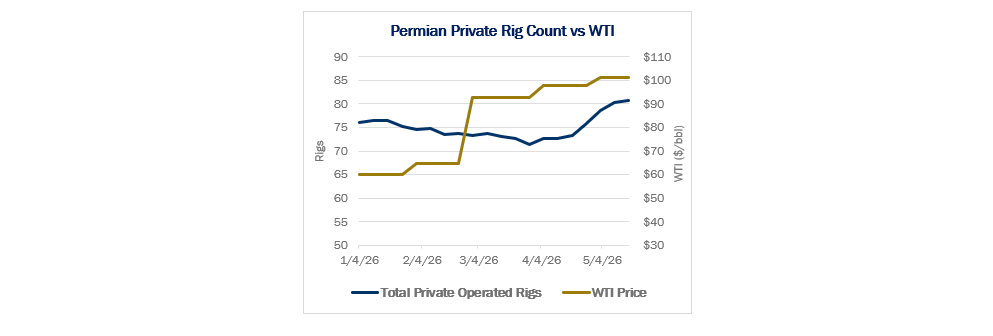
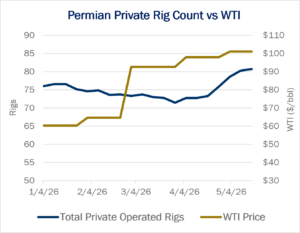
Since late March, private operators have added 11 rigs in the Permian, bringing the collective private rig count to 82 for the week ending May 17 (see figure). The gains have come from companies like Continental, Double Eagle, Triple Crown and VTX. These private operators have added 1 rig apiece recently.
Over the same seven-week period, publicly held producers have added 1 rig net in the Permian. ExxonMobil (XOM), which has guided to 10% supply growth in 2026, added 2 rigs and is now running 36 in the basin. BP, EOG Resources (EOG) and ConocoPhillips (COP) are each running 1 additional rig. On the flip side, Matador Resources (MTDR) idled 3 rigs and Ovintiv (OVV) dropped 1 rig over the last two months. The public rig count in the Permian stands at 173 for the week ending May 17 vs 172 at the end of March.
The divergence between public and private operators is consistent with historical behavior. Our research shows that when price signals improve, private operators are more likely to respond by adding rigs. When prices weaken, they are more likely to pull back. Privates are also quicker to react than their public counterparts when oil prices move up or down.
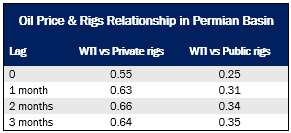 The historical relationship between Permian rig activity and WTI prices is shown in the table to the right. Ignoring for time delays, privates overall are much more responsive to price fluctuations, demonstrating a 55% correlation between drilling decisions and changes to WTI prices vs only a 25% relationship for public E&Ps.
The connection strengthens when considering the lag between when oil prices change and Permian operators adjust their drilling programs. For privates, the strongest relationship occurs when WTI price changes lead rig activity by roughly two months. The correlation is 66% for privates on a two-month lag.
For perspective, oil prices surged in early March following the onset of the Iran conflict. So the recent jump in Permian drilling by privates has arrived right on schedule, based on the historical relationship between rigs and prices.
Public producers are slower to respond; this group is most likely to adjust their Permian rig activity three months after WTI prices move. Even then, the relationship between rigs and WTI prices is only 35%.
The slower and less-elastic response by public E&Ps makes sense. These operators are sensitive to shareholder pressure, so their activity is more influenced by capital discipline and long-term development plans. Nevertheless, several bumped up their annual guidance in 1Q26 earnings, a sign that more attractive oil prices are starting to influence investment decisions.
Looking ahead, East Daley expects the Permian rig count to continue rising, reaching a near-term peak of 285 rigs in September. We forecast Permian crude production reaches 7.0 MMb/d by YE26 and 7.2 MMb/d by YE27.
As long as the Iranian conflict supports stronger WTI prices, private operators (and eventually publics) will continue to drive rig additions in the Permian, supporting our higher production outlook.
Supply & Demand:
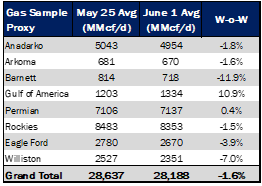 The US natural gas pipeline sample, a proxy for change in oil production, decreased 1.6% W-o-W for the May 25 week across all liquids-focused basins.
The Barnett (-11.9%) and the Williston (-7.0%) posted the largest decreases for the week, followed by the Eagle Ford (-3.9%), Anadarko (-1.8%), Arkoma (-1.6%) and the Rockies (-1.5%). Volumes increased in the Gulf of America (+10.9%) and the Permian (+0.4%). The Rockies and the Gulf of America have a high correlation between gas volumes and crude oil volumes, whereas the Permian and Eagle Ford basins correlation is less than 45%.
As of June 8, there are no current refinery outages.
Vessel traffic monitored by East Daley along the Gulf Coast decreased W-o-W. A total of 27 vessels were loaded for the week ending June 6, a large decrease from the previous week.