



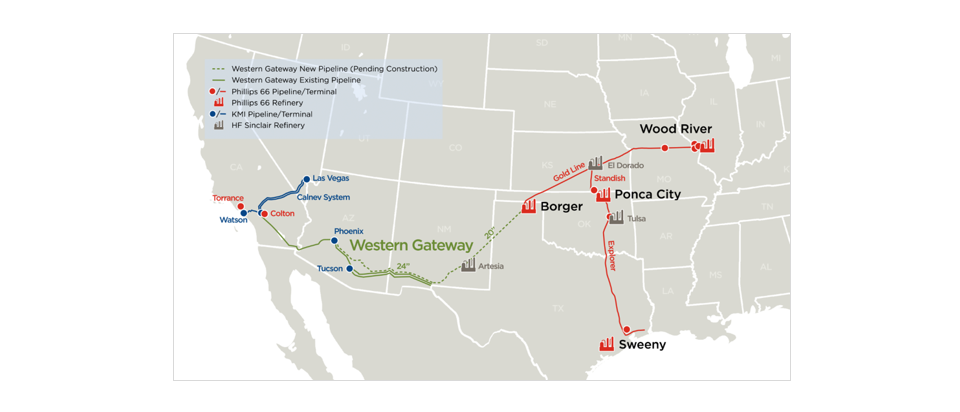
Rigs: The total US rig count decreased to 589 for the week of Aug. 15.
Infrastructure: California’s refinery closures are widening the state’s refined products deficit. Western Gateway is a long-term bet by Phillips 66, Kinder Morgan and HF Sinclair on tighter West Coast supply and stronger product pricing.
Supply and Demand: The US natural gas pipeline sample, a proxy for change in oil production, decreased 1.1% W-o-W across all liquids-focused basins for the week ending Aug. 19.
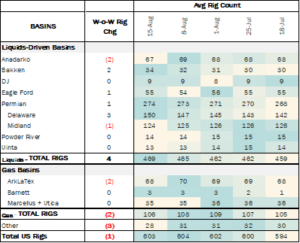
Rigs:
The total US rig count decreased to 603 for the week of Aug. 15. Liquids-driven basins increased to 469, up 4 rigs W-o-W.
- Anadarko (-2): American Warrior, Upland Operating
- Bakken (+2): Petro-Hunt, Zavanna Energy
- Eagle Ford (+1): Cimarron Engineering
- Permian (+1):
- Delaware (+2): Continental Resources, Perun Energy, VF Petroleum
- Midland (-1): ExxonMobil
Infrastructure:
California’s refined products market is back in the spotlight after Phillips 66 (PSX), Kinder Morgan (KMI) and HF Sinclair (DINO) reached a final investment decision (FID) on the Western Gateway Pipeline. The near-term widening of California’s supply-demand gap, combined with the short-term inelasticity of oil consumption, is a recipe for structural increases in product prices in the West.
 The partners announced FID on Western Gateway on Aug. 11. The 1,300-mile project is designed to move up to 230 Mb/d of gasoline, diesel and jet fuel from Midwest and Gulf Coast refineries to Arizona, California and Nevada demand centers.
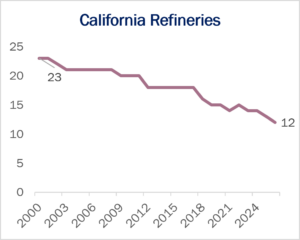
The $5B joint venture will supply California with much-needed refined products without building new refining infrastructure in the state. East Daley Analytics has highlighted California’s challenging market conditions: Valero shut down the 145 Mb/d Benicia refinery in April, and Phillips 66 shuttered its 139 Mb/d Las Angeles refinery in 4Q25. The two closures removed ~17% of California’s refined products from the market, part of a long-term decline in the state’s refining sector (see figure).
The capital split for Western Gateway is notable. KMI is contributing both the SFPP East and West lines (assessed at an enterprise value of $1.5B), plus $250MM in cash. PSX will contribute $2.5B to the project, and DINO is expected to provide $750MM.
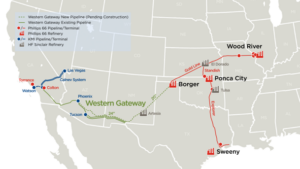
Western Gateway will add 900 miles of new 20- and 24-inch pipe from Borger, TX to Phoenix, AZ, drawing on both Phillips 66 and HF Sinclair refineries for products, and will feed demand in Phoenix, Los Angeles and Las Vegas (see project map below from KMI Investor Relations). It also includes multiple flow reversals. KMI will reverse its SFPP West line, now planned to flow from Phoenix, AZ to Colton, CA, and PSX will reverse its Gold Line, which will now move product from St. Louis, MO to Borger, TX.
East Daley estimates the project’s first full year of gross EBITDA at ~$564MM (3Q29–2Q30). Compared to a total enterprise value of $5B, that equates to an EBITDA build multiple of ~8.8x — a direct bet on a lasting California supply gap.
Phillips 66 (49.9% stake) touches every vertical in this project: revenue from the refineries feeding the system, transportation of the barrels, and optionality to market those same barrels downstream.
Kinder Morgan (35.1% stake) will earn returns by rolling SFPP East and West into the venture at a $1.5B valuation, plus a high EBITDA margin on its $250MM cash contribution. HF Sinclair, the smallest partner with a 15% interest, buys itself a guaranteed outlet for El Dorado barrels, with vertical-integration benefits similar to Phillips 66’s.
Supply and Demand:
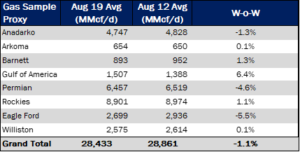 The US natural gas pipeline sample, a proxy for change in oil production, decreased 1.1% W-o-W for the week of Aug. 19 across all liquids-focused basins.
Volumes decreased notably in the Permian (-4.6%) and Eagle Ford (-5.5%), with a slight decreases in the Anadarko (-1.3%). Volumes increased in the Gulf of America (+6.4%), Rockies (+1.1%), Williston (+0.1%) and the Barnett (+1.3%).
As of Aug. 25, there are no refinery outages.
Vessel traffic monitored by East Daley along the Gulf Coast notably decreased W-o-W. A total of 25 vessels were loaded for the week ending Aug. 22, a decrease of 12 from the prior week.