



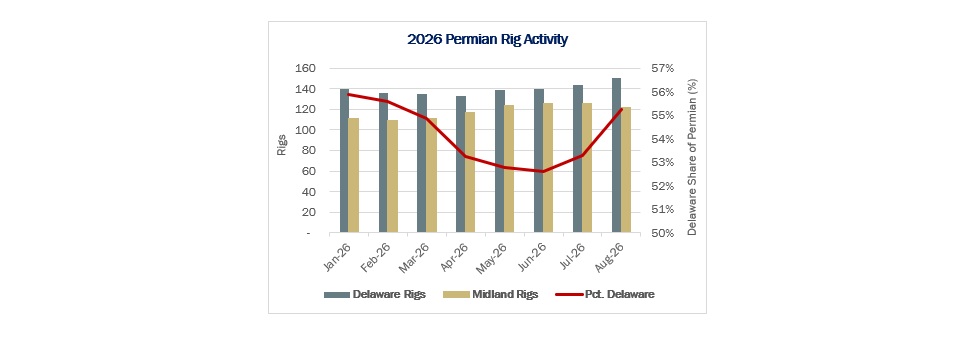
Rigs: The total US rig count decreased to 601 the week of Aug. 29.
Infrastructure: Permian growth is becoming more broad-based in 2026, with Exxon still leading but Diamondback, Permian Resources, Matador, OXY and ConocoPhillips all contributing meaningful production gains.
Supply and Demand: The US natural gas pipeline sample, a proxy for change in oil production, increased 0.2% W-o-W across all liquids-focused basins for the week ending Sept. 2.
Rigs:
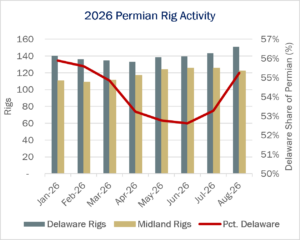
The total US rig count decreased to 601 the week of Aug. 29. Liquids-driven basins decreased to 462, down 2 rigs W-o-W.
- Anadarko (+1): Eiger Operating
- Permian (-5)
- Midland (-3): Double Eagle (-2), Summit Petroleum (-1)
- Delaware (-2): Matador Resources, Northstar Resources

Infrastructure:
With 2Q26 earnings wrapped up, East Daley’s review of Permian producer guidance points to a broader growth story than at the start of the year. ExxonMobil (XOM) remains the largest driver, but it is no longer the only operator pointing to meaningful gains given higher oil prices.
Exxon expects Permian production to increase from 1.6 MMboe/d in 2025 to roughly 1.8 MMboe/d in 2026, implying about 12.5% growth. The major also reported record Permian production in 2Q26 above 1.8 MMboe/d. Diamondback Energy (FANG) is moving higher as well, raising its full-year production guidance to 1.0+ MMboe/d from 921 Mboe/d in 2025, implying at least 8.6% growth.
 Permian Resources (PR) is guiding to a production midpoint of ~415 Mboe/d from 393 Mboe/d last year, or 5.7% growth, while its updated oil guidance midpoint reached 199 Mb/d. Matador Resources (MTDR) is guiding to 221 Mboe/d from 207 Mboe/d in 2025, a 6.7% increase. Matador’s updated guide includes expected production from the pending Paloma and Ridge Runner acquisitions; excluding those contributions, management expects 6% Y-o-Y organic oil growth.
Occidental Petroleum (OXY) is also pointing higher, with 2026 Permian guidance of 801–817 Mboe/d vs 786 Mboe/d in 2025. The 809 Mboe/d midpoint implies roughly 2.9% Y-o-Y growth. ConocoPhillips (COP) does not provide formal full-year Permian guidance, but reported record 2Q26 Permian production of 922 Mboe/d vs an 853 Mboe/d average in 2025. Management separately said underlying Permian production increased 10% Yo-Y during 1H26.
The upward guidance revisions are as a result of meaningfully higher oil prices, driven up by the Iran conflict. Prompt-month WTI prices traded over $93/bbl Tuesday, up about $30 since the start of the year.
However, not every producer is joining the push. Chevron (CVX) is managing Permian production around 1 MMboe/d, a level it has said it plans to sustain for years. APA’s 123 Mb/d US oil guidance is about 2% below its reported 2025 US oil production average of 125.5 Mb/d. EOG Resource’s 5% oil and 14% total production growth outlook is companywide, and partly reflects the annualization of its Encino acquisition in the Utica.
Devon Energy (DVN) does not break out a standalone Permian production target, but the Permian remains its largest capital focus at $2.9B in 2026, suggesting the basin will remain a key driver of the company’s output following the Coterra merger. SM Energy (SM) raised its 2H26 production outlook to 435–440 Mboe/d from 430 Mboe/d, while oil production remains roughly flat at 238 Mb/d. Crescent Energy’s 331 Mboe/d guidance midpoint is roughly 27% above its reported 260 Mboe/d 2025 average, but the comparison is heavily distorted by the Vital Energy acquisition, which closed in December 2025, and should not be viewed as organic Permian growth.
The broader takeaway is that Permian growth is becoming less concentrated. Exxon still leads the basin, but stronger guidance and operating results from Diamondback, Permian Resources, Matador, Occidental and ConocoPhillips show a wider group of operators contributing to the growth outlook, giving the 2026 production story more depth than it had at the start of the year.
Supply and Demand:
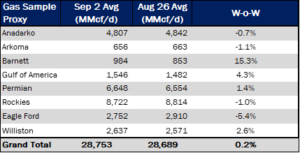 The US natural gas pipeline sample, a proxy for change in oil production, increased 0.2% W-o-W for the week of Sept. 2 across liquids-focused basins.
Volumes increased considerably in the Barnett (+15.3%) and Gulf of America (+4.3%), with slight increases in the Permian (+1.4%) and the Bakken (+2.6%). Volumes decreased in the Anadarko (-0.7%), Arkoma (-1.1%), Rockies (-1%), and Eagle Ford (-5.4%). The Rockies and the Gulf of America have a high correlation between gas volumes and crude oil volumes, whereas the Permian and Eagle Ford basins correlation is less than 45%.
As of Sept. 8, there are no refinery outages.
Vessel traffic monitored by East Daley along the Gulf Coast slightly increased W-o-W. A total of 26 vessels were loaded for the week ending Sept. 5, up 2 from the prior week