



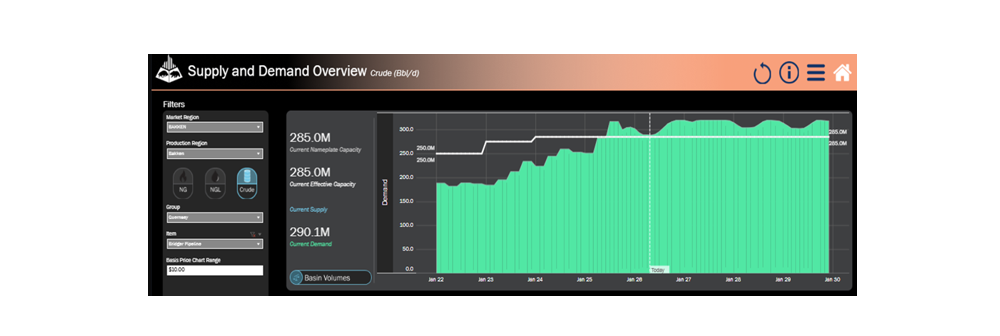
Rigs: The total US rig count held steady at 540 rigs for the week of May 9.
Infrastructure: Kinder Morgan’s refurbishing of Double H Pipeline is proving a bonanza for competitor True Companies and its Bridger system in the Bakken
Supply & Demand: The US natural gas pipeline sample, a proxy for change in oil production, increased 0.8% across liquids-focused basins for the week ending May 18.
Rigs:
The total US rig count held flat at 540 rigs for the week of May 9. Liquids-driven basins decreased W-o-W to 413 from 414.
- Bakken (-1): Kraken Resources
- Permian
- Delaware (+1): VTX Energy Operating
- Midland (-1): Exxon
- Powder River (-1): Ballard Petroleum
- Uinta (+1): Scout Energy Partners
Infrastructure:
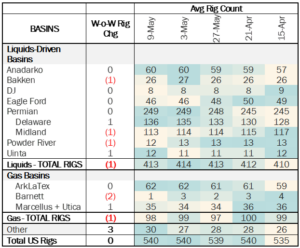
Kinder Morgan’s (KMI) refurbishing of Double H Pipeline is proving a bonanza for competitor True Companies and its Bridger system in the Bakken. The pipeline moved crude oil volumes far exceeding its nameplate capacity in 4Q25, a likely sign of the gains ahead in a tighter midstream market for Bakken crude.
Bridger shipped ~340 Mb/d in 4Q25 from the Bakken to the Guernsey hub in Wyoming, according to quarterly filings with the Federal Energy Regulatory Commission (FERC), up from 317 Mb/d in 3Q25 and 19% above its nameplate capacity of 285 Mb/d (see the throughput outlook for Bridger from East Daley Analytics’ Crude Hub Model, available in Energy Data Studio).
The gains for Bridger coincide with the period when KMI shut down Double H to prepare the former oil pipeline for NGL service. Shippers began migrating off Double H in 3Q25, and KMI temporarily closed the pipeline in 4Q25 to make upgrades for the transition. Bridger also recorded a big jump in volumes in 3Q25, picking up Bakken barrels that had formerly moved on Double H.
The filings show that Bridger has sustained operations over its nameplate capacity for at least six months. The consistency of the flows suggests True is using drag-reducing agents (DRAs) to raise the pipeline’s effective capacity.
Notably, Bridger has picked up nearly all the Bakken barrels displaced by the Double H closure. Flows on Dakota Access Pipeline (DAPL), which carries crude to the Patoka hub in Illinois, declined from 525 Mb/d in September 2025 to 492 Mb/d in January 2026, despite ~750 Mb/d of capacity and ample room to take on additional volumes.
Enbridge’s (ENB) North Dakota Pipeline (NDPL), another route from the Bakken to Patoka, was already running effectively full prior to the Double H conversion. Volumes on NDPL averaged ~218 Mb/d over the latest six months, near its 220 Mb/d capacity.
The gains for Bridger highlight the significance of True Companies’ recently announced expansion to access Canadian crude. Bridger proposes to build a 550 Mb/d, 36-inch crude oil pipeline from Phillips County, MT to Guernsey. With the pipeline already operating well above nameplate, the project would sustain current throughput more efficiently while accommodating additional barrels from growing Alberta production. Until that capacity comes online, Bridger will likely remain the primary outlet absorbing displaced flows, even as other systems run below capacity.
Downstream, Guernsey can only absorb some of the barrels from the proposed project. Effective egress capacity out of Guernsey is currently ~88% utilized, according to East Daley’s Crude Hub Model. Among key outlets, Platte Pipeline is running at ~74% utilization and offers the most immediate headroom. However, Pony Express, the primary route from Guernsey, was already moving ~12 Mb/d over its 300 Mb/d nameplate capacity in 3Q25.
We anticipate that Pony Express will need to be expanded, either through added pump stations or DRAs, if True constructs the Bridger expansion. Tallgrass Energy on March 31 concluded a joint season with Bridger to secure shipper commitments on Pony Express, with an eye to future expansions.
Supply & Demand:
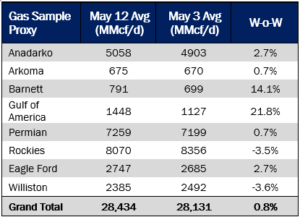 The US natural gas pipeline sample, a proxy for change in oil production, increased 0.8% W-o-W across all liquids-focused basins.
Volumes increased in most basins, with the exception of the Rockies (-3.5%) and the Williston (-3.6%). Both the Arkoma and Permian basins saw minimal increases of 0.7%, and the Anadarko and Eagle Ford basins each increased 2.7% W-o-W. The most notable gains came from the Barnett (14.1%) and the Gulf of America (21.8%). The Rockies and the Gulf of America have a high correlation between gas volumes and crude oil volumes, whereas the Permian and Eagle Ford basins correlation is less than 45%.
As of May 18, there are no current refinery outages.
Vessel traffic monitored by EDA along the Gulf Coast increased W-o-W. A total of 36 vessels were loaded for the week ending May 16. East Daley expects this figure to continue rising as long as the Strait of Hormuz remains under blockade.