



Permian gas constraints and capital discipline could blunt the traditional supply response from the spike in WTI prices.
WTI crude prices jumped to nearly $120/bbl last Monday (March 9), and after a volatile week traded around $99 late Friday afternoon (March 13). However, the spike is unlikely to drive incremental supply from the Permian Basin in 2026.
The constraint is not economics but infrastructure: Limited natural gas takeaway restricts producers’ ability to increase drilling activity. Until new pipelines such as Blackcomb and Hugh Brinson add a combined 4.7 Bcf/d of capacity by YE26, producers will struggle to move associated gas – and therefore crude – out of the basin.
This dynamic matters because the Permian is the largest oil-producing region in the US. In previous cycles, higher oil prices typically trigger increased drilling activity and supply growth from the basin. However, producers today face a structural bottleneck that limits their ability to respond to price signals.
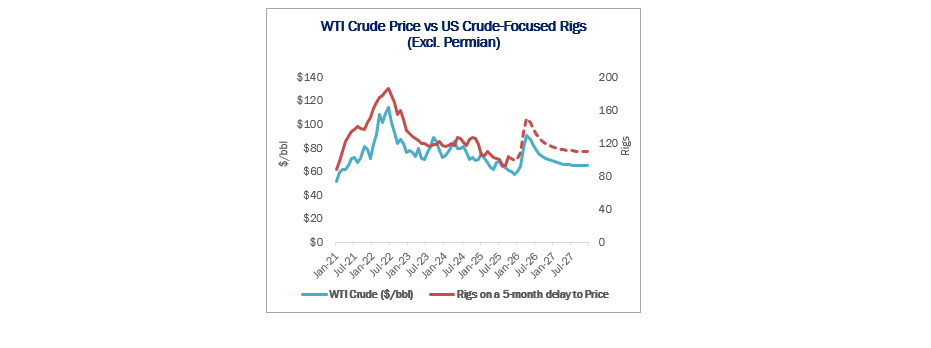
 If the Permian cannot respond, the market will naturally look to other liquids-rich basins to provide incremental supply. The Bakken, Rockies, Anadarko and Eagle Ford plays have historically increased drilling activity when oil prices rise. Data from East Daley Analytics’ Energy Data Studio shows that rig activity in these basins typically responds to WTI price movements with roughly a five-month lag (refer to the graph).
At first glance, the connection suggests that higher prices could encourage operators in these basins to increase drilling and bring additional supply to market. However, two structural factors are likely to blunt the customary price response.
The first is the signal coming from the oil forward curve. WTI futures are steeply backwardated. While the Apr ‘26 contract traded near $99/bbl Friday, WTI prices for 4Q26 are closer to $76-79. Producers are unlikely to materially increase capital budgets based on a price spike that the market expects to be temporary.
The second constraint is capital allocation flexibility. Several producers with exposure to the Bakken, Rockies and Anadarko also maintain significant positions in the Permian. Operators like Devon Energy (DVN) can shift capital across basins. With new gas takeaway capacity expected to come online in the Permian by late 2026, these operators may be reluctant to redirect capital toward other regions for what could prove to be a short-lived opportunity.
As a result, the pool of producers positioned to capitalize on a short-term oil price spike is relatively small. The companies most likely to benefit are those with limited hedge exposure and existing operational capacity, including available drilling contracts and pipeline takeaway in basins outside the Permian.
A handful of operators fit this profile. Companies such as EOG Resources (EOG), Chord Energy (CHRD) and Civitas Resources (CIVI) have the scale and flexibility to opportunistically capture higher prices without committing to large, long-term increases in capital spending.
In the near term, Permian infrastructure constraints, backwardated oil prices and capital discipline could limit the typical supply response to higher crude prices. While a price spike would still improve cash flows for producers, it may not translate into the rapid production growth the market has come to expect from US shale. – Rob Wilson, CFA Tickers: CHRD, CIVI, DVN, EOG.
 Download Part II of East Daley’s Permian Basin White Paper Series
The Permian Basin’s next big buildout is already taking shape, but this time the driver isn’t crude oil. In The Permian Basin at a Crossroads: Why This Pipeline Boom is Different, East Daley Analytics’ latest white paper reveals how gas demand from AI data centers, utilities and LNG exports is rewriting the midstream playbook in the leading US basin. Over 10 Bcf/d of new capacity and $12 billion in investments are reshaping flows, turning the Permian into a gas powerhouse even as rigs decline. Read Part II: Why This Pipeline Boom is Different
Meet Daley, the Best AI Tool in Energy
Meet Daley, the newest member of our energy team. Our new AI assistant is live and available to all East Daley Analytics clients. Early feedback has been phenomenal. Daley is platform-specific and only pulls from East Daley’s own proprietary data and content. It’s not open-source or generic AI, but built to understand our structure, language and analytics. Whether you’re looking for a specific metric, forecast or explanation, Daley can get you there quicker. — Reach out to learn more about Daley!
The Daley Note
Subscribe to The Daley Note for energy insights delivered daily to your inbox. The Daley Note covers news, commodity prices, security prices and EDA research likely to affect markets in the short term.