



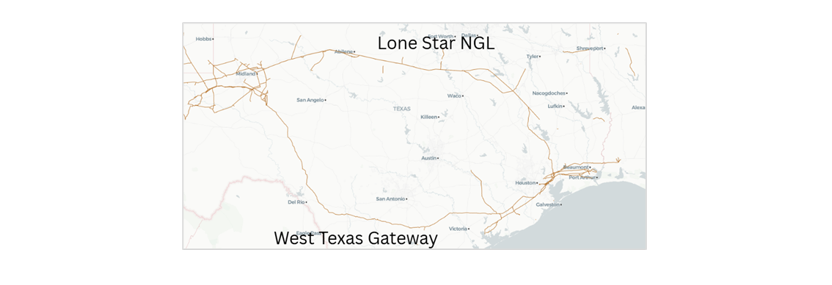
Energy Transfer (ET) is evaluating whether to convert a Permian NGL trunkline to natural gas service, a move that would ride industry momentum for more gas egress from the basin. The company hasn’t revealed which asset it is considering, but East Daley speculates that the West Texas Gateway (WTG) system is the likeliest target.
On ET’s 3Q25 earning call, management said converting the candidate pipe could roughly double revenue in gas vs NGL service given weak NGL rates and strong gas demand. East Daley expects Permian Y-grade takeaway to be overbuilt as competitors build new NGL pipelines to Mont Belvieu, including Targa Resources’ (TRG) 500 Mb/d Speedway line and Enterprise Products’ (EPD) Bahia system. The market trend makes redeploying “excess” NGL steel into a gas corridor strategically appealing.
If Energy Transfer pulls the trigger, the project would add to the industry bandwagon for new gas pipelines out of the Permian Basin. In the Permian Supply & Demand model, EDA expects over 10 Bcf/d of new Permian gas takeaway through 2030 from projects with a final investment decision (FID), including several by ET. The WhiteWater joint venture backing the Eiger Express Pipeline recently upsized the project to 3.7 Bcf/d. In the near term, WhiteWater’s Blackcomb (+2.5 Bcf/d) and ET’s Hugh Brinson Pipeline (+2.2 Bcf/d) are scheduled to start through 2027. Eiger Express and ET’s Desert Southwest (+1.5 Bcf/d) add more takeaway by the end of the decade.
West Texas Gateway is Plausible Conversion Candidate
East Daley views WTG as a plausible candidate for a conversion project. WTG is a 16-inch NGL pipeline running 570 miles from Winkler County, TX to ET’s Jackson County processing plant on the Gulf Coast. The line has a capacity of ~209 Mb/d and has been in service since 2012. Other pipelines move NGLs north from the WTG system to Mont Belvieu.
WTG was built under hazardous liquids code (Title 49 Code of Federal Regulations [CFR] Part 195); converting the line to gas would place it under Title 49 CFR Part 192 regulations. The project would trigger tighter rules on maximum allowable operating pressure (MAOP), class locations, high-consequence areas (HCAs) and integrity management, per the conversion guidance from the Pipeline and Hazardous Materials Safety Administration (PHMSA).
Using a Panhandle-style scaling for a modern 42-inch, 400-mile line with ~1.5 Bcf/d of capacity, EDA estimates WTG could support only 100–200 MMcf/d of gas transport with added compression. Our capacity and horsepower estimates assume similar MAOP and pressure windows between the reference pipe and a gas conversion. In reality MAOP can vary, so this is a directional estimate.
Assuming 90% utilization and a long-haul tariff in the $0.60–0.80/MMBtu range (based on posted rates for Whistler Pipeline), we estimate $30–50MM in annual revenue and $20–30MM/yr of EBITDA. A realistic liquids-to-gas conversion likely runs $200–400MM (~15–25% of a greenfield 16-inch build), putting payback in the 8– to 15-year band.
Lone Star Express: Better Steel, Bigger Tradeoff
The 30-inch Bosque–Mont Belvieu leg of the Lone Star Express/Gulf Coast NGL Express system is another conversion candidate. The line moves up to 475 Mb/d of Y-grade and is fed by a 352-mile, 24-inch expansion from Winkler County.
Scaling the same hydraulics, a 30-inch, ~180-mile gas segment could move roughly 0.8–1.0 Bcf/d. At 90% utilization and a $0.60–0.70/MMBtu tariff, that yields $165–240MM of annual revenue and ~$120–180MM/yr of EBITDA.
Building a greenfield replacement project at costs similar to Targa’s Speedway (~$3–3.5MM/mile for a 30-inch NGL pipe) implies $0.6–0.8B for an equivalent gas line. A full conversion that reuses the steel but adds compression and meets CFR Part 192 regulations would likely run $250–400MM in Capex (~30–50% of a greenfield project). The project economics point to a 3– to 5-year payback and clearly superior project economics vs a WTG conversion.
Our Take: Based on engineering and cash flow comparisons, the 30-inch Lone Star Express leg is the best NGL-to-gas conversion candidate in ET’s portfolio. However, Lone Star is also a core artery to ET’s Mont Belvieu fractionation complex, creating big tradeoffs for the NGL business from a conversion. West Texas Gateway, while a smaller-bore line with modest EBITDA, is an easier asset to sacrifice in an increasingly long NGL pipeline market. In East Daley’s view. WTG is a more plausible conversion candidate, even if it is not the optimal steel in the ground. – Jaxson Fryer, David Bartle Tickers: EPD, ET, TRGP.
 The Permian Basin at a Crossroads: Download the Latest White Paper
The Permian Basin is the heart of the US energy industry, supplying half of crude oil and NGL production and nearly 20% of natural gas. Yet market pressures are forcing changes, prompting billions in new pipeline investments and reorienting how operators approach the basin. East Daley’s new white paper, The Permian Basin at a Crossroads, is the first of a 3-part series looking at the shifts underway in the Permian. In this series, we reveal how LNG demand and AI data centers could transform Permian gas into a primary revenue driver. We also review the multi-billion-dollar infrastructure needed to unlock this shift, and what’s at stake for oil, gas and midstream operators. — Click here to download the The Permian Basin at a Crossroads white paper!
Meet Daley, the Best AI Tool in Energy
Meet Daley, the newest member of our energy team. Our new AI assistant is live and available to all East Daley Analytics clients. Early feedback has been phenomenal. Daley is platform-specific and only pulls from East Daley’s own proprietary data and content. It’s not open-source or generic AI, but built to understand our structure, language and analytics. Whether you’re looking for a specific metric, forecast or explanation, Daley can get you there quicker. — Reach out to learn more about Daley!
The Daley Note
Subscribe to The Daley Note for energy insights delivered daily to your inbox. The Daley Note covers news, commodity prices, security prices and EDA research likely to affect markets in the short term.