



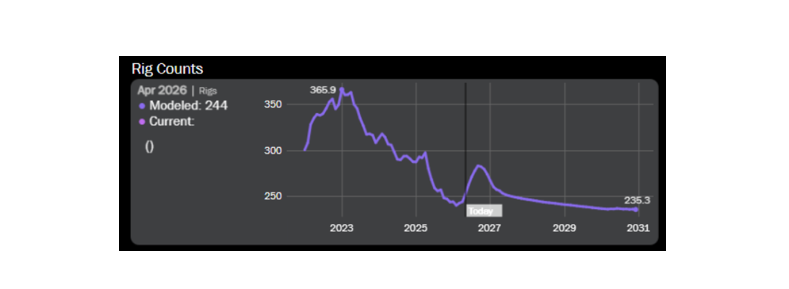
Rigs: The total US rig count increased to 552 for the week of May 10.
Infrastructure: East Daley’s updated survey of Permian Basin operators points to 3.3% growth in oil production in 2026, or a gain of ~223 Mb/d.
Supply & Demand: The US natural gas pipeline sample, a proxy for change in oil production, was flat across liquids-focused basins for the week ending May 26.
Rigs:
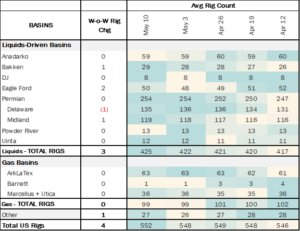
The total US rig count gained 4 rigs to 552 for the week of May 10. Liquids-driven basins added 3 rigs W-o-W to 425.
- Bakken (+1): Devon Energy
- Permian
- Delaware (-1): Exxon
- Midland (+1): SM Energy
- Eagle Ford (+2): EOG Resources, Magnolia Oil & Gas
Infrastructure:
Producers are responding to higher crude oil prices, albeit slowly. East Daley Analytics’ updated survey of Permian Basin operators points to 3.3% growth in oil production in 2026, or a gain of ~223 Mb/d. The results from 1Q26 earnings are up from 2.7% growth in our post-4Q25 earnings survey.
In Energy Data Studio, we estimate Permian oil production increases from an average of 6.82 MMb/d in 2025 to ~7.05 MMb/d in 2026.
ExxonMobil (XOM) continues to be the growth engine in the basin. XOM expects to grow its Permian oil production by ~11.0% in 2026, adding 108 Mb/d Y-o-Y. That represents about 44% of the basin-wide increase captured in our survey. Exxon is also the most active operator in the Permian, running 34 rigs in late April, including 26 Midland rigs and 8 Delaware rigs.
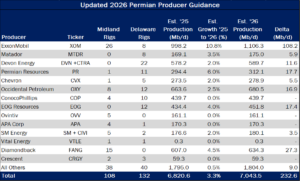
The updated guidance shows a broad contribution from the next tier of producers. We model Chevron (CVX) at 2.0% growth, adding ~5 Mb/d, while Diamondback (FANG) raised its Permian growth guidance to 4.5% from 2.5%, or ~27 Mb/d. We expect EOG and Permian Resources (PR) to increase production by ~17 Mb/d each, growing 4.0% and 6.0% respectively. Matador Resources (MTDR) also bumped its guidance to 3.5% growth from 2.5%.
Several Permian operators have merged since our last survey. Devon Energy (DVN) and Coterra Energy completed their merger on May 7. The producers, now operating as Devon, will report combined guidance in mid-June. In the meantime, DVN reported 1Q26 oil production on the top end of its previous guidance, prompting us to raise the outlook for the merged E&P to 2% Permian growth.
SM Energy (SM) and Civitas Resources completed their merger in January 2026 under the ‘SM’ ticker, and 1Q26 production came in higher than the guidance midpoint. The combined producer is guiding to 2% growth in 2026, including 11 months of Civitas contributions.
Crescent Energy (CRGY) acquired Vital Energy in December 2025; however, CRGY does not consider the Permian as one of its key basins and has reduced its drilling program to just 2 rigs in the Midland and 3 in the Delaware. East Daley doesn’t expect Crescent’s production to increase in 2026 based on its guidance.
Despite the higher growth estimate, the broader message has not changed: Permian growth is positive, but still highly concentrated in the hands of a few companies. Higher WTI prices could continue to move production expectations at the margin, but Permian operators are likely to remain disciplined until new gas pipelines create more room for growth in the back half of 2026.
Supply & Demand:
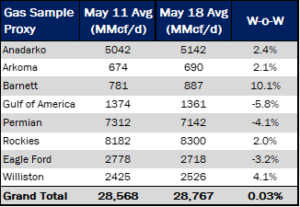 The US natural gas pipeline sample, a proxy for change in oil production, was essentially unchanged W-o-W across liquids-focused basins.
Volumes were mixed by basin, with the Barnett (+10.1%) and Gulf of America (-5.8%) having the most notable changes W-o-W. The Rockies (+2.0%), Arkoma (+2.1%), Anadarko (+2.4%) and Williston (+4.1%) all saw increases, while the Eagle Ford (-3.2%) and Permian (-4.1%) decreased. Basin-level movements largely offset one another, leaving overall to relatively steady volumes. The Rockies and the Gulf of America have a high correlation between gas volumes and crude oil volumes, whereas the Permian and Eagle Ford basins correlation is less than 45%.
As of May 26, 74.5 Mb/d of refining capacity is offline for maintenance. Valero’s Corpus Christi East refinery accounts for the offline capacity due to a power outage. The refinery is expected to operate at full capacity by the end of the week.
Vessel traffic monitored by East Daley along the Gulf Coast decreased W-o-W. A total of 28 vessels were loaded for the week ending May 23. However, East Daley expects this figure to rise as long as the Strait of Hormuz remains under blockade.