



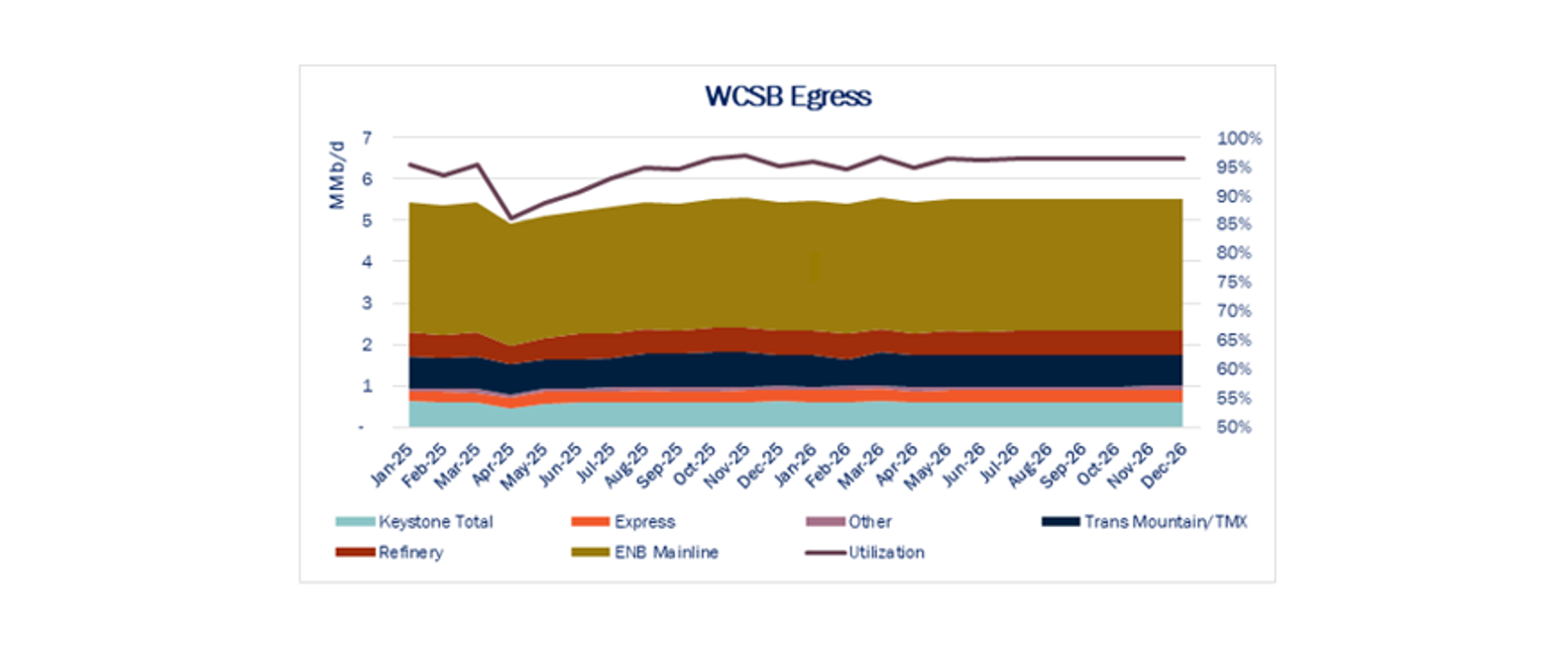
Rigs: The total US rig count decreased to 569 rigs for the week of June 27.
Infrastructure: Western Canada’s pipeline outlook is returning to focus as crude production growth begins to absorb the spare capacity created by the Trans Mountain Expansion (TMX).
Supply and Demand: The US natural gas pipeline sample, a proxy for change in oil production, increased 2.2% W-o-W across all liquids-focused basins for the week ending July 6.
Rigs:
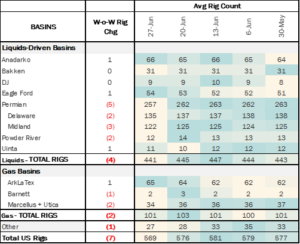
The total US rig count decreased by 7 rigs to 569 for the week of June 27. Liquids-driven basins declined from 445 to 441 rigs.
- Anadarko (+1): King Energy LLC
- Eagle Ford (+1): Formentera Partners
- Permian (-5)
- Delaware (-2): Matador Resources
- Midland (-3): Chevron Corporation; Halliburton Operating Company; Kinder Morgan, Inc
- Powder River (-2): 1876 Resources LLC; Continental Resources
- Uinta (+1): Wem Operating, LLC
Infrastructure:
Western Canada’s pipeline outlook is returning to focus as crude production growth begins to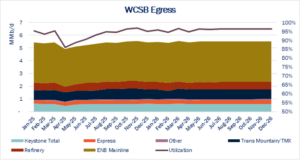 absorb the spare capacity created by the Trans Mountain Expansion (TMX). Since entering service in 2024, TMX has significantly increased export capacity to Canada’s West Coast, easing takeaway constraints and improving access to international markets.
Recent developments also highlight the growing importance of Asia as a destination for Canadian crude. Canada and Japan recently expanded their strategic partnership to include energy cooperation, while Alberta officials met with Japanese stakeholders to discuss crude imports and refinery upgrades capable of processing oil sands barrels. These discussions underscore the value of westbound export capacity as producers seek greater exposure to Asian demand.
As TMX utilization increases, attention is shifting toward the next generation of egress projects. Trans Mountain is evaluating opportunities to add incremental capacity to its existing system, while South Bow continues advancing its Prairie Connector project, targeting a mid-2027 FID. The project would provide additional export capacity and direct access to U.S. Gulf Coast refining markets.
Enbridge’s Line 26 expansion recently received regulatory approval to increase Canadian crude movements through the Bakken into DAPL. Because it relies largely on existing infrastructure, it appears to be one of the most achievable near-term expansion opportunities. Meanwhile, Alberta is expected to formally submit its proposed West Coast pipelineconcept on July 1, though the project remains in the early stages of development.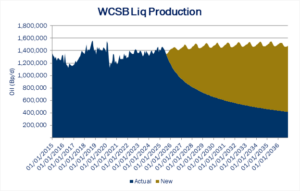
East Daley’s WCSB Production Model projects enough crude supply growth to consume much of the capacity added by TMX over the next decade, supporting the need for additional takeaway capacity. While several large-scale proposals have emerged, projects that leverage existing infrastructure, including TMX optimization, Line 26, and Prairie Connector, appear to have the highest likelihood of moving forward. Given today’s regulatory and commercial environment, incremental expansions remain more likely than another major greenfield crude pipeline. – Amelia Johnson.
Supply and Demand:
The US natural gas pipeline sample, a proxy for change in oil production, increased 2.2% W-o-W for the June 22 week across all liquids-focused basins.
The Permian (7.1%) posted the largest increase for the week, followed by the Barnett (3.6%), Gulf of America (2.4%), Rockies (0.9%), and Arkoma (0.5%). Volumes decreased in Eagle Ford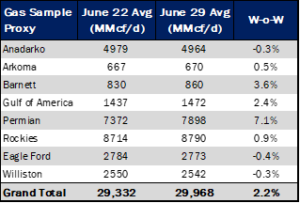 (-0.4%), Williston (-0.3%), and Anadarko (-0.3%). The Rockies and the Gulf of America have a high correlation between gas volumes and crude oil volumes, whereas the Permian and Eagle Ford basins correlation is less than 45%.
As of July 6, 93.5 Mb/d is offline due to planned maintenance on the Par Pacific East Refinery in Kapolei, Hawaii. The refinery is expected to run at full capacity by the end of the month.
Vessel traffic monitored by EDA along the Gulf Coast decreased W-o-W. A total of 22 vessels were loaded for the week ending July 4, a slight decrease from the previous week.