



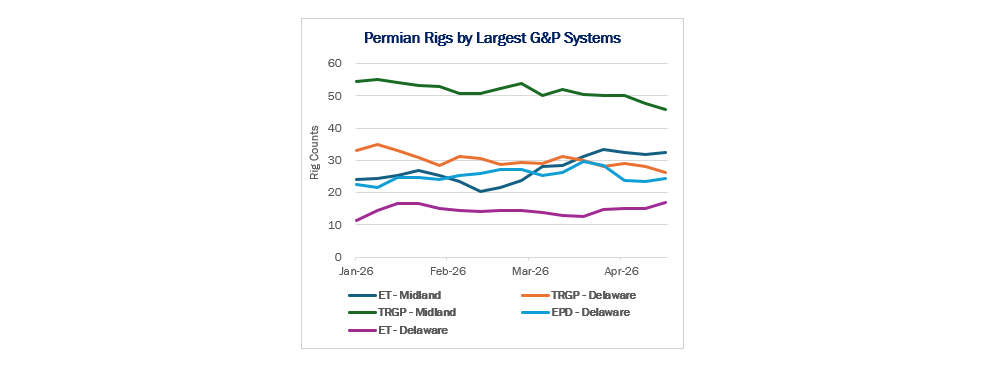
Energy investors know the growth story. Permian volumes are rising. Producer activity is shifting, and new wells are coming online. But growth alone doesn’t answer the questions that matter most to investors: Which midstream systems will capture the next tranche of volumes, who owns them, and what does that mean for EBITDA?
East Daley rebuilt our G&P rig allocation model to help answer those questions.
Over the past eight months, our team completed a major rebuild of the model that connects producers and supply to specific G&P systems across the Lower 48. The work included reviewing more than 300 existing systems, creating 25+ new systems, and checking more than 5,800 pipeline location points across 100+ transmission pipelines.
The purpose was not simply to improve a dataset. It was to give investors a clearer, more defensible way to understand where future volumes are likely to flow — and which companies are positioned to benefit.
One example is rig allocation. A basin-level rig count shows where activity is increasing, but it doesn’t reveal which midstream assets are likely to capture the resulting production. East Daley’s model goes beyond drawing a simple geographic box around a system. It uses refined system footprints, delivery points, ownership, reported volumes and historical transactions to connect producer activity to the G&P systems most likely to receive future volumes.
The updates make rig counts more useful as a leading indicator. If rigs are active around a specific system today, investors can begin to assess where new volumes may show up in future quarters — before that growth appears in reported results.
The distinction matters because two midstream companies can both claim exposure to the same basin, and still have very different outcomes. One may own assets directly in the path of producers, with the connectivity and capacity to turn new production into throughput, utilization and cash flow. Another may have basin exposure on paper, but limited ability to capture the next wave of volumes.
The rebuilt model helps investors move from market generalities to actionable conclusions. It reveals which systems are positioned to capture the growth, the companies that own them, and where EBITDA could surprise.
For public market investors, the results can help identify upside or downside vs consensus. For private market investors, it can support diligence, underwriting, downside cases and asset valuation. For banks, it can strengthen pitches and transaction analysis, creating a clearer link between physical volumes and financial outcomes.
If you have looked at G&P data before, it is worth taking a fresh look.
Bring us a company, basin or asset you care about. East Daley can show you how future production growth may translate into system-level throughput, ownership exposure and potential EBITDA impact. – Jaxson Fryer.


Join East Daley’s May Production Stream Webinar
East Daley Analytics will host our monthly Production Stream webinar on Wednesday, May 27. Midstream infrastructure is becoming the defining bottleneck in North American energy markets — and the value of infrastructure is poised to rise significantly in the years ahead:
- US natural gas pipelines are operating at high utilization rates, making firm transportation increasingly strategic and valuable.
- Emerging demand like data centers and LNG export facilities require reliable baseload supply.
- Combined, we expect these sectors to drive more than 20 Bcf/d of long-term natural gas demand by 2030.
- Crude pipeline systems are facing similar constraints as producers push utilization limits to move oil to the coast.
- Fractionation bottlenecks in the Permian continue to tighten NGL logistics, raising critical questions about how the industry will respond.
 Our analysts will break down emerging infrastructure constraints, and their implications for the future of midstream energy and new investment opportunities. Join our Production Stream webinar on Wednesday, May 27.
Download Part II of East Daley’s Permian Basin White Paper Series
The Permian Basin’s next big buildout is already taking shape, but this time the driver isn’t crude oil. In The Permian Basin at a Crossroads: Why This Pipeline Boom is Different, East Daley Analytics’ latest white paper reveals how gas demand from AI data centers, utilities and LNG exports is rewriting the midstream playbook in the leading US basin. Over 10 Bcf/d of new capacity and $12 billion in investments are reshaping flows, turning the Permian into a gas powerhouse even as rigs decline. Read Part II: Why This Pipeline Boom is Different
The Daley Note
Subscribe to The Daley Note for energy insights delivered daily to your inbox. The Daley Note covers news, commodity prices, security prices and EDA research likely to affect markets in the short term.
[/vc_column_text][/vc_column][/vc_row]