



Executive Summary:
Infrastructure: The market understands the macro shift toward US LPG exports to India, but the real differentiation lies in terminal-level responses, where infrastructure determines who captures the incremental demand.
Exports: NGL exports rose 8.3% W-o-W for the week ending March 6, driven by LPG exports, which increased 23.5% W-o-W.
Rigs: The total US rig count decreased during the week of Feb. 28 from 525 to 521. Liquids-driven basins decreased W-o-W from 391 to 390.
Flows: US natural gas volumes in pipeline samples gained 0.5% W-o-W, averaging 82.2 Bcf/d for the week ending March 8.
Calendar: Macro S&D and NGL Production update
Infrastructure:
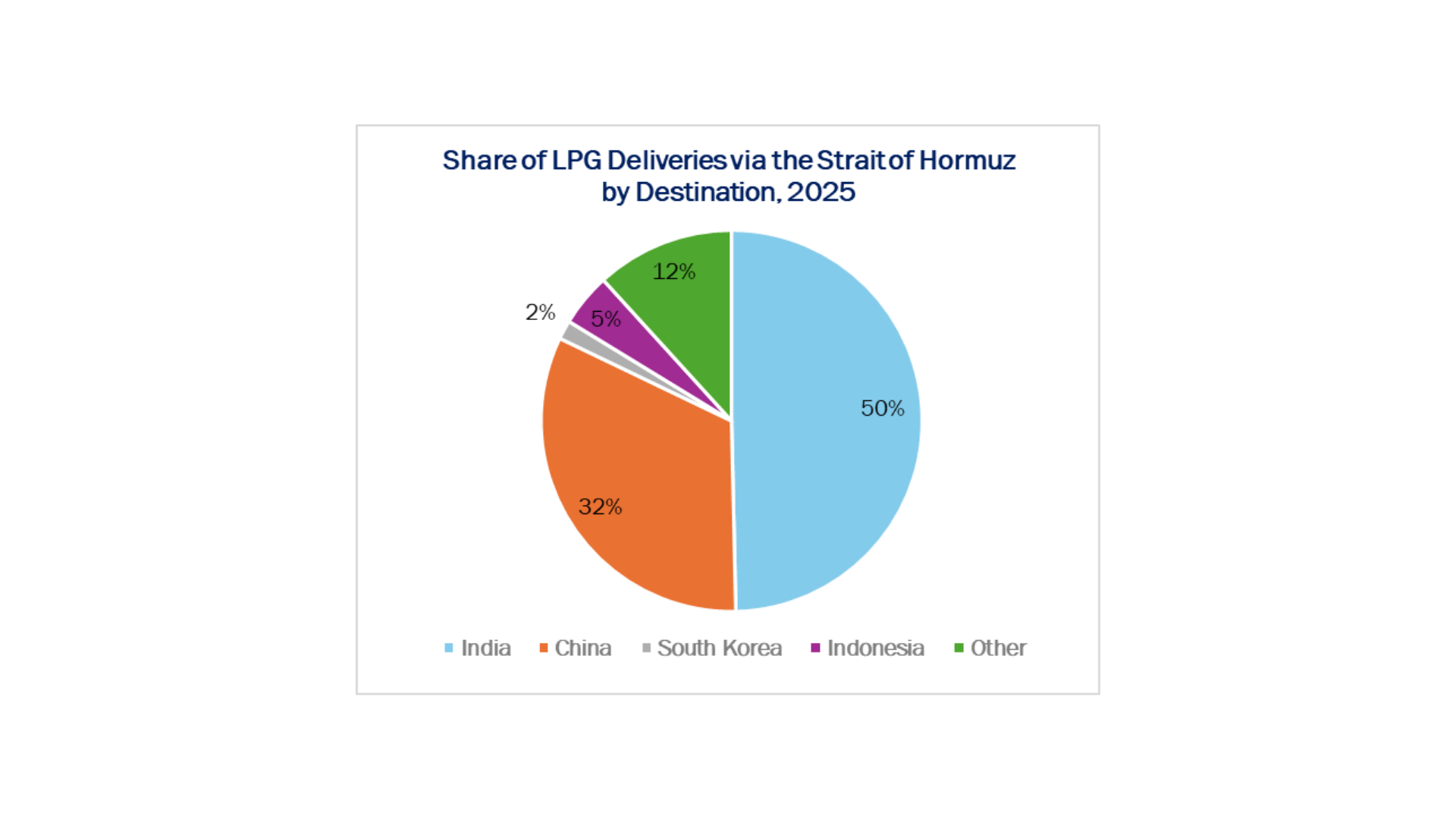
The market already understands the macro story: India cannot easily replace Persian Gulf LPG cargoes disrupted by the Iran war, and the US is the only scalable alternative. The next layer of analysis is where East Daley Analytics has the edge. This will not be a uniform US export response. It will be a terminal-by-terminal response.
The binding constraint is no longer simply LPG availability. It is export infrastructure. Which docks have open capacity, which operators have flexibility in product mix, and which terminals can actually move additional barrels into India over the next 30 to 45 days?
India’s residential LPG demand requires blended cargoes of propane and butane, adding another layer of constraint to the US export response. Not every terminal can easily assemble mixed LPG cargoes, and butane-handling capacity in particular is already tight at several key facilities.
Energy Transfer’s (ET) Nederland terminal appears effectively maxed out on butane capacity. While the company is planning storage and infrastructure expansions, those additions will not be available in the near term. Phillips 66’s (PSX) Freeport terminal is similarly running near capacity. That leaves a smaller group of facilities capable of increasing shipments in the short term, primarily Targa Resource’s (TRGP) Galena Park and Enterprise Products’ (EPD) Hydrocarbons terminals.
Operational disruptions also compound the constraint. Recent fog events along the Gulf Coast delayed vessel movements and left several cargoes backed up at export docks. East Daley’s latest LPG export model shows roughly 100 Mb/d of theoretical spare capacity across PADD 3 terminals for March 2026, though filling that space may prove difficult given product mix limitations and scheduling delays.
Outside the Gulf Coast, ET’s Marcus Hook terminal provides another potential outlet. East Daley estimates roughly 75 Mb/d of available export capacity there, though cargoes would face longer sailing distances to India.
Looking ahead, Enterprise’s Neches River Phase 2 expansion could materially shift the export picture if disruptions persist. The project is scheduled to begin service in 2Q26. If operational in early April, it could capture a significant share of incremental demand, potentially adding as much as 360 Mb/d of export capacity.
In the near term, replacement supply from the US to India will likely emerge unevenly, with cargoes concentrated at terminals that have both spare dock space and the ability to assemble blended LPG barrels.
Exports:
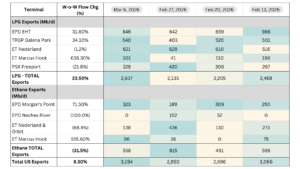
NGL exports rose 8.3% W-o-W for the week ending March 6, driven by LPG exports, which increased 23.5% W-o-W.
LPG exports increased 23.5% W-o-W, supported by higher volumes across most terminals, led by Marcus Hook, which surged 638% (+260 Mb/d).
Ethane exports declined 31.5% W-o-W, as gains at Morgan’s Point (+71.5%) were offset by lower volumes at Neches River, Nederland and Orbit.
Rigs:
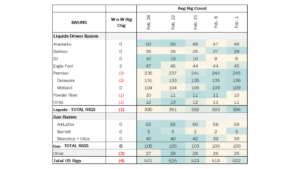
The total US rig count decreased during the week of Feb. 28 from 525 to 521. Liquids-driven basins decreased W-o-W from 391 to 390.
- Eagle Ford (+2): Chevron
- Permian
- Delaware (-2): Coterra Energy
- Powder River: (-1): EOG Resources
- Uinta (-1): Uinta Wax Operating
Flows:
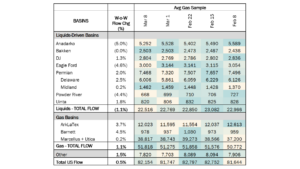
Note: East Daley has vetted our US pipeline samples and upgraded the data tagging, resulting in a more robust capture of production trends from the daily samples.
US natural gas volumes in pipeline samples gained 0.5% W-o-W, averaging 82.2 Bcf/d for the week ending March 8.
Flows in gas basins increased 1.1% to 51.8 Bcf/d. The Haynesville sample increased 3.7% to 12 Bcf/d, and the Marcellus+Utica gained 0.2% W-o-W at 38.8 Bcf/d.
Samples in liquids basins declined 1.1% W-o-W to 22.5 Bcf/d. The Permian sample increased 2.0%, while the Anadarko sample declined 5.0%.
Calendar: