


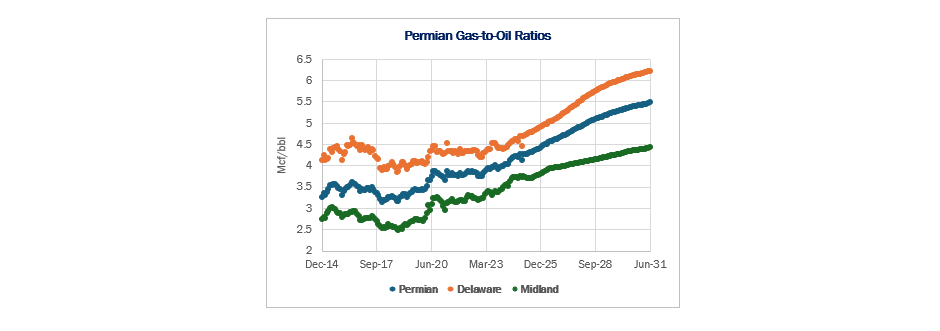
Hydrocarbon production from the Permian Basin is growing gassier. Depending on where you sit in the industry, the trend is a source of immense frustration, or a driver of new opportunities.
 Rising gas-to-oil ratios (GOR) from Permian wells is one of the most widely discussed industry topics. Upstream investors, who favor higher-priced liquids production over natural gas, view it as a drag on equities. But growing Permian gas production is spurring a range of investments by midstream companies, from pipelines to processing plants, to capitalize on the trend in an otherwise uncertain outlook for crude oil.
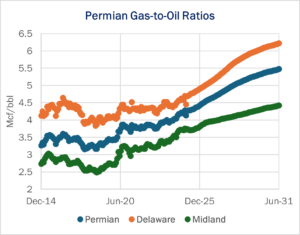
East Daley’s review of Permian well data finds several drivers for rising GORs. First, operators are migrating toward the Delaware sub-basin, where target formations yield relatively more gas than oil compared to the Midland (see chart at right). Second, the Permian has a large base of maturing wells, and as oil wells age and reservoir pressure declines, more methane is released from hydrocarbon formations. The GOR increase is partly mathematical, partly geologic, and partly driven by development evolution.
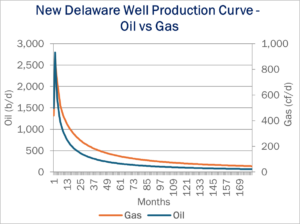
The decline dynamic is easy to see in the average new Delaware well, shown in the chart below. Oil production falls sharply in the early months, while gas volumes flatten more gradually, meaning a well’s GOR trends higher as the curves separate.
To quantify this behavior, East Daley Analytics uses the Production Durability Index (PDIₓ) — defined as the number of months it takes for production in a well to deplete to X% of its peak rate.
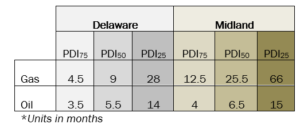 Across both Permian sub-basins, gas production is consistently more durable than oil — but this effect is amplified in the Midland. Gas production from a Midland well takes 12.5 months on average to fall to 75% of its peak, compared with 4 months for oil production in a Midland well (see PDI table at right). In the Delaware, the gap is smaller — 4.5 vs 3.5 months — but still directionally consistent.
This difference shapes how each sub-basin contributes to Permian supply:
- Delaware wells deliver higher absolute volumes thanks to stronger initial production (IP) rates.
- Midland wells deliver longer life — their slow-declining gas tails provide a structural uplift to basin-wide GORs and long-term gas supply.
Put simply: Delaware drilling gives you the magnitude; the Midland gives you longevity. And even though Midland gas declines more slowly, Delaware wells still produce more total gas because they start at higher IPs.
Bottom line: This is a structural effect driven by physics, not targeted gas drilling. Modern development and natural decline behavior are steadily pushing the Permian toward a more gas-weighted production profile, simply because that is what the wells give you. – Julian Renton and Maria Paz Urdaneta.
The Permian Basin at a Crossroads: Why This Pipeline Boom is Different
The Permian’s next big buildout is already taking shape, but this time the driver isn’t oil. East Daley Analytics’ latest white paper reveals how gas demand from AI data centers, utilities and LNG exports is rewriting the midstream playbook. Over 10 Bcf/d of new capacity and $12 billion in investments are reshaping flows, turning the Permian into a gas powerhouse even as rigs decline. Read Part II: Why This Pipeline Boom is Different
Meet Daley, the Best AI Tool in Energy
Meet Daley, the newest member of our energy team. Our new AI assistant is live and available to all East Daley Analytics clients. Early feedback has been phenomenal. Daley is platform-specific and only pulls from East Daley’s own proprietary data and content. It’s not open-source or generic AI, but built to understand our structure, language and analytics. Whether you’re looking for a specific metric, forecast or explanation, Daley can get you there quicker. — Reach out to learn more about Daley!
The Daley Note
Subscribe to The Daley Note for energy insights delivered daily to your inbox. The Daley Note covers news, commodity prices, security prices and EDA research likely to affect markets in the short term.