



Executive Summary:
Infrastructure: An arctic air mass is expected to cause temperatures to plunge in Texas and the Permian Basin beginning Friday night, placing the full NGL supply chain at risk during the event.
Exports: Total US exports fell by 12% W-o-W for the week ending Jan. 16, driven by declines in both LPG and ethane shipments across most terminals.
Rigs: The total US rig count increased by 9 during the week of Jan. 10, from 515 to 524.
Flows: US natural gas volumes in pipeline samples averaged 68.2 Bcf/d for the week ending Jan. 11, down 1.6% W-o-W.
Calendar:Ethane, Propane and Butane S&Ds updates.
Infrastructure:
A massive winter storm is expected to push through Texas and the Permian Basin this weekend, placing the full NGL supply chain at risk during the event.
A winter storm watch is in effect for all of West Central Texas from Friday afternoon through early Sunday (Jan. 23-25), according to the National Weather Service. An arctic air mass is expected to bring freezing rain, sleet and snow beginning Friday night, with temperatures falling into the single digits at times. The affected region overlaps with the Permian Basin’s core producing, gathering and processing corridors, and will likely disrupt NGL operations during the coldest periods.
The Permian Basin at a Crossroads: Download Why This Pipeline Boom is Different
The Permian’s next big buildout is already taking shape — but this time, the drivers aren’t producers chasing oil. East Daley’s latest white paper reveals how gas demand from AI data centers, LNG exports, and utilities is rewriting the midstream playbook. Over 9 Bcf/d of new capacity and $12 billion in investments are reshaping flows, turning the Permian into a gas powerhouse even as rigs decline. Read Part II: Why This Pipeline Boom is Different
Freeze-offs impact NGL supply when extreme cold envelops multiple points in the delivery system simultaneously. Wellheads can freeze over, gathering systems can lose pressure, and gas processing plants can be forced to curtail or operate below nameplate. When any link breaks, NGL recovery drops immediately.
Recent extreme winter events show this pattern clearly. During Winter Storm Enzo in January 2025, US ethane supply fell 6–7.5% M-o-M while propane supply declined 4–6%. Permian freeze-offs accounted for most of the losses. Winter Storm Heather in early 2024 and Elliott in December 2022 produced similar outcomes: Cold snaps triggered mid-single-digit declines in NGL supply as wells, gathering systems and processing plants all experienced weather-related disruptions.
Texas’ post-Uri weatherization rules have reduced the risk of prolonged, system-wide outages. Critical gas infrastructure, including wells, processing plants and pipelines tied to the electricity supply chain, is now required to maintain operations during weather emergencies or face significant penalties, according to regulations set by the Texas Railroad Commission. Even so, weatherization does not eliminate freeze risk. Localized equipment failures, inlet pressure losses and reduced recovery rates have continued to surface during recent storms.
Exports:
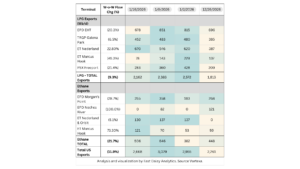
Total US exports fell by 12% W-o-W for the week ending Jan. 16, driven by declines in both LPG and ethane shipments across most terminals. LPG exports decreased by 9.3%, while ethane exports fell more sharply, down 21.7%.
LPG export declines were led by a 45.3% drop at Marcus Hook, alongside smaller declines at most other terminals. ET Nederland was the exception, with exports up 22.8%.
Similarly, ethane exports increased by 73.3% at Marcus Hook but declined across all other terminals. Most notably, Neches River recorded a 100% drop in exports, falling from 82 Mb/d to zero.
Rigs:
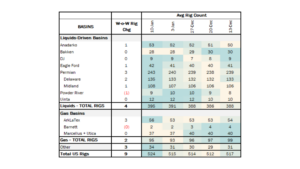
The total US rig count increased by 9 during the week of Jan. 10, from 515 to 524. Liquids-driven basins increased by 4 rigs W-o-W, from 391 to 395.
- Anadarko (+1): Petroquest Energy
- Eagle Ford (+1): SM Energy
- Permian:
- Delaware (+2): EOG Resources, ConocoPhillips
- Midland (+1): ExxonMobil
- Powder River (-1): WRC Energy
Flows:
US natural gas volumes in pipeline samples averaged 68.9 Bcf/d for the week ending Jan. 18, down 1.1% W-o-W.
Flows in major gas basins declined 1.4% W-o-W to 42.0 Bcf/d. The Haynesville sample slid 0.8% to 9.5 Bcf/d, while the Marcellus+Utica declined 1.8% to 31.7 Bcf/d. The Barnett sample jumped 7.0% higher W-o-W.
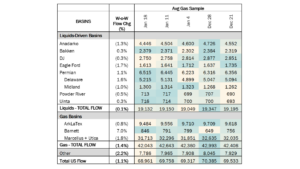
Samples in liquids-focused basins were mostly flat, decreasing 0.1% to 19.1 Bcf/d. The Permian sample gained 1.1% to 6.5 Bcf/d, and the Eagle Ford sample declined 1.7% W-o-W.
Calendar: