



Executive Summary:
Infrastructure: Fractionators in Louisiana are running below 50% capacity, a far cry from the near-100% utilization East Daley forecasts for fracs in Mont Belvieu, TX.
Exports: NGL exports declined 12.4% W-o-W for the week ending Feb. 13.
Rigs: The total US rig count decreased during the week of Feb. 7 from 527 to 525. Liquids-driven basins decreased by 2 rigs W-o-W from 397 to 395.
Flows: US natural gas volumes in pipeline samples increased 1.9% W-o-W, averaging 71.5 Bcf/d for the week ending Feb. 15.
Calendar: Macros S&D updates and NGL report Feb. 23
Infrastructure:
While NGL fractionators in southeastern Texas are running all-out, ample frac capacity is available across the state line in Louisiana. Yet for several reasons, the NGL market may never take advantage of this potential relief valve for growing supply.
Fractionators in Louisiana are running below 50% capacity, a far cry from the near-100% utilization East Daley forecasts for fracs in Mont Belvieu, TX. According to the NGL Hub Model, fractionators in Louisiana have 680 Mb/d of combined capacity yet typically only average 30-40% utilization, leaving plenty of spare capacity available to absorb growth in Y-grade production.
Most midstream operators target Mont Belvieu as the preferred market to build fracs and sell NGL purity products. Growth at Mont Belvieu has coincided with investments in several nearby export terminals on the Texas Gulf Coast, creating ready markets for ethane and LPGs.
However, some barrels still move out of the region. Two main pipelines, Cajun Sibon and LouTex, move Y-grade from Mont Belvieu to Louisiana fracs. Cajun Sibon and LouTex have a combined capacity of 290 Mb/d, and as of 3Q25, throughput on these pipe averaged 258 Mb/d, or ~89% utilization. In the NGL Hub Model, East Daley data provides clear visibility into fractionation volumes in the region.


The data shows that fractionated volumes closely track pipeline volumes moving from Mont Belvieu to fracs in Louisiana (see figure). This suggests that most of those inbound barrels are being fractionated. Even so, total fractionated volumes remain well below the state’s overall fractionation capacity.
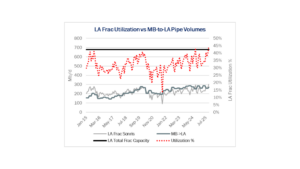
Utilization at Louisiana fracs has increased slowly but steadily since 2022, though pipeline constraints limit further gains. Using the remaining ~30 Mb/d of capacity on Cajun Sibon and LouTex, would lift utilization at the state’s fracs by only a few percentage points, still leaving about half of the regional frac capacity idle.
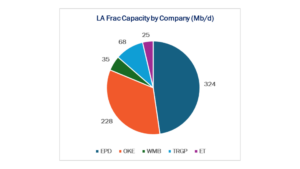
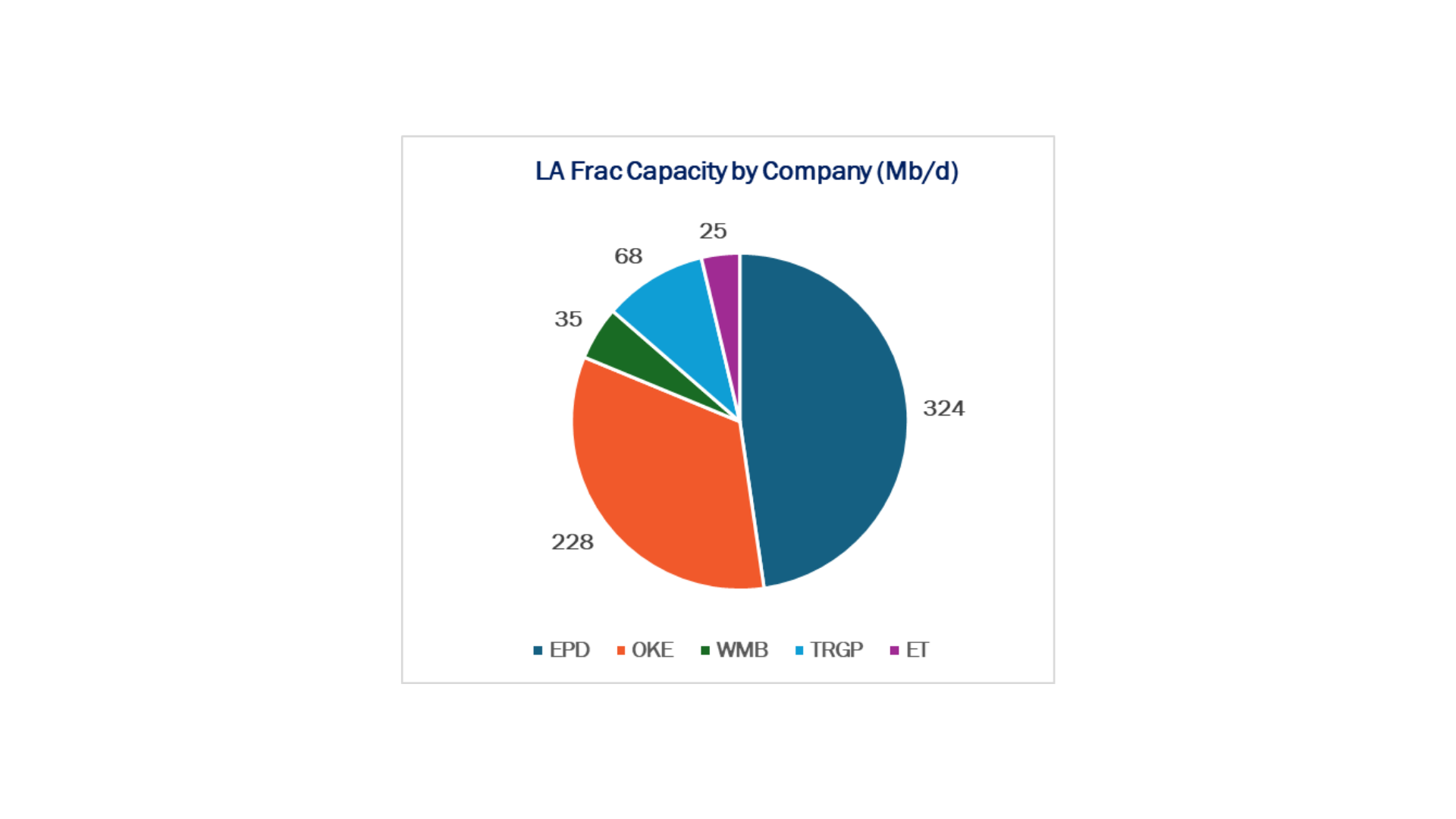
Enterprise Products (EPD) and ONEOK (OKE) own most of the unused Louisiana fractionation capacity, and are most exposed to the region’s downstream bottleneck. This creates a potential incentive for these operators to pursue expansion or additional connectivity.
While incremental pipeline capacity from Mont Belvieu could support modest volume growth, a more structural solution would involve improving market access out of Louisiana, either through stronger links back to Mont Belvieu or direct connections to export infrastructure. Removing these downstream constraints would be key to unlocking the full value of Louisiana fractionation assets.
Exports:
NGL exports declined 12.4% W-o-W for the week ending Feb. 13.
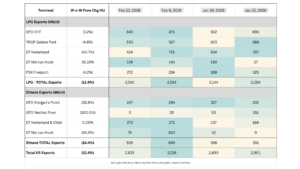
The pullback was broad-based across LPG terminals. While Marcus Hook posted a 36.3% increase, all other major terminals reported lower volumes. Nederland saw the largest reduction, falling 40.7% W-o-W, or 291 Mb/d.
Ethane exports also moved lower across all terminals, decreasing 14.4% W-o-W in aggregate.
Rigs:
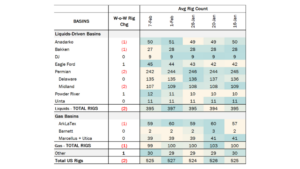
The total US rig count decreased during the week of Feb. 7 from 527 to 525. Liquids-driven basins decreased by 2 rigs W-o-W from 397 to 395.
- Anadarko (-1): Validus Energy
- Bakken (-1): Petro-Hunt
- Eagle Ford: (+1): Strand Energy
- Permian:
- Midland (-2): Medders Oil, ExxonMobil
- Powder River (+1): WRC Energy
Flows:
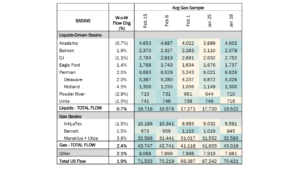
US natural gas volumes in pipeline samples increased 1.9% W-o-W, averaging 71.5 Bcf/d for the week ending Feb. 15.
Flows in gas basins rose 2.4% as output continued to recover from impairments caused by Winter Storm Fern in late January and early February. The Marcellus+Utica sample increased 3.6% to 32.6 Bcf/d, while the Haynesville sample declined1.5% W-o-W to 10.2 Bcf/d.
Calendar: