



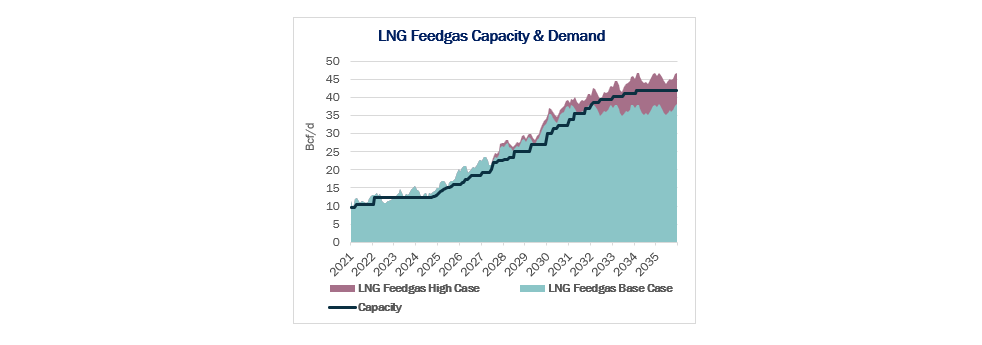
The US LNG buildout continues to advance, but the industry’s next constraint may be securing enough natural gas to feed it. East Daley Analytics expects gas demand for LNG to approach 35 Bcf/d by 2035, creating a priority for developers and offtakers to lock down supply.
The US currently has eight commercially operating facilities that require about 15.5 Bcf/d of gas. Plaquemines LNG and Golden Pass LNG Train 1 are also taking in feedgas, contributing ~4.5 Bcf/d more demand. Trains 2-3 at Golden Pass will add another 1.5 Bcf/d, bringing total US LNG feedgas demand to roughly 21.5 Bcf/d and operating liquefaction capacity to ~123 Mtpa.
And developers are not slowing down. The Department of Energy recently authorized Argent LNG to export up to ~3.6 Bcf/d from its proposed Port Fourchon, LA terminal to countries with US free trade agreements. Argent is planning up to 25 Mtpa of capacity, which would make the project one of the Gulf Coast’s largest proposed terminals. Argent’s non-FTA permit is still pending and its sponsors have announced no commercial agreements, but it is a project to watch.
Other developers are committing capital and equipment well before completing the regulatory and commercial process. Venture Global (VG) has ordered six Baker Hughes liquefaction blocks for a proposed 11.7 Mtpa expansion of CP2 LNG. The equipment could support roughly 1.5 Bcf/d of incremental feedgas demand. Combined with a separate proposal to uprate CP2’s existing facilities, the terminal could eventually reach ~46.7 Mtpa (6.3 Bcf/d).
NextDecade (NEXT) is also expanding Rio Grande LNG beyond the five trains already sanctioned or under construction. Trains 1-2 and the common facilities were 74% completed as of June 2026, while Train 3 completion exceeded 50%. NEXT expects first gas in late 2026, followed by first LNG from Train 1 in 1H27.
 NEXT is targeting a 2H27 final investment decision (FID) for the 6.03 Mtpa Train 6 at Rio Grande, following a final environmental impact statement scheduled for June 2027. The developer also plans to enter pre-filing at the Federal Energy Regulatory Commission (FERC) for Trains 7 and 8 by YE26. Those expansions could add another 12 Mtpa and move Rio Grande toward its long-term target of roughly 60 Mtpa (8 Bcf/d).
The continued development reinforces a structural shift in the US gas market toward demand-driven growth. Once all Golden Pass trains are brought online, US LNG feedgas demand should approach 21.5 Bcf/d. Projects that have already reached FID could lift demand to roughly 35 Bcf/d by 2035, an increase of about 14 Bcf/d from the near-term baseline (see figure).
Including other projects that East Daley expects to reach FID, demand would grow to ~46 Bcf/d, or 25 Bcf/d above the near-term level. Ten additional projects remain in the early stages of development and represent another 19.5 Bcf/d of potential demand if they operate at their proposed capacity. If all projects are brought online at their listed capacity, LNG exports would grow to 443 Mtpa (~59 Bcf/d) of operating capacity.
New Permian pipelines will help deliver additional supply to the Gulf Coast, but transportation capacity will not solve the entire problem. Producers must eventually move beyond their lowest-cost drilling inventory, raising the price required to support production growth. East Daley expects Henry Hub prices to approach $5/MMBtu by 2031.
The first phase of US LNG growth was defined by building terminals. The next will be defined by which developers can secure low-cost feedgas through firm transportation, while preserving the flexibility to compete through periods of global oversupply and price volatility. – Emily Cecchini Tickers: NEXT, VG.
Demand is Coming. Where Will the Supply Come from — and Who’s Going to Deliver?
The largest growth cycle in US energy demand is on deck, and the infrastructure required to meet it could reshape US energy markets over the next decade.
LNG infrastructure in the Lower 48 and Mexico could grow by 45 Bcf/d by 2035, while gas-fired power generation serving data centers could add another 7.6 Bcf/d of natural gas demand. More than 32 Bcf/d of major pipeline expansions and newbuild projects have already been proposed to connect growing supply with LNG, power, residential and commercial demand.
And natural gas is only part of the story.
- Midstream consolidation is accelerating as operators position themselves from wellhead to water, including Williams’ move to acquire Momentum.
- Nearly 1,200 Mb/d of Y-grade and purity product expansions are proposed out of the Permian alone, while Mont Belvieu could face more than 1,000 Mb/d of fractionation constraints by 2032.
- A possible ATEX conversion project from liquids to gas could unleash more Northeast supply and reshape NGL flows in the region.
- Permian crude oil takeaway is already running tight, with routes to Corpus Christi at 99% utilization and Cushing/Houston routes at 92%. With only about 75 Mb/d of expansions on the books, takeaway capacity could become a constraint on future Permian growth.
- Roughly $32B per year of infrastructure has been sanctioned and underwritten by long-term contracts through 2031 — representing more than $191B of committed capital over the next five years.
Where are the biggest infrastructure gaps? Which projects get built? And which companies are positioned to capture the opportunity?
Join East Daley Analytics on August 26 at 10:00 AM MT as we connect the dots across natural gas, NGLs, crude oil and capital investment to map the infrastructure buildout ahead. Click here to register now and reserve your spot.
One Market, One Model: Gain a Holistic View of North America Supply & Demand
East Daley Analytics is pleased to announce the Canada Supply & Demand report. The Canada S&D completes our North American model, providing a fully integrated supply and demand forecast for crude oil and natural gas. East Daley follows molecules from Canadian production through US infrastructure to end-markets. Clients now have a continental view to anticipate trends, from how Canadian gas is reshaping Midwest markets, to how crude imports flow to Gulf Coast refiners. The Canada S&D report and dataset is available exclusively in Energy Data Studio. Reach out to learn more about East Daley’s North American energy model.
The Daley Note
Subscribe to The Daley Note for energy insights delivered daily to your inbox. The Daley Note covers news, commodity prices, security prices and EDA research likely to affect markets in the short term.