



Commonwealth LNG has been in the news after project developer Caturus announced full commerciality and the launch of project financing in early April, on the way to a final investment decision (FID). The company is marketing a “wellhead-to-water” strategy, pairing the $12.5B LNG project with the pending acquisition of SM Energy’s (SM) Galvan Ranch acreage in South Texas. It’s a compelling narrative East Daley Analytics is familiar with. But in this case, the midstream link between wellhead and water is unclear to us.
The main risk we see for Commonwealth is the lack of a defined header system. Nearly every other LNG facility on the Texas-Louisiana Gulf Coast has a dedicated header pipeline connecting to the Gillis or Katy hubs. Commonwealth proposes to interconnect with the ANR and Bridgeline pipelines. However, those systems are fully contracted long-term along that route, despite available physical capacity. Owning upstream production doesn’t solve for the supply problem if the molecules can’t move to the plant on firm transport.
Commonwealth has a diverse portfolio, signing offtake agreements with Glencore, Mercuria, Petronas, Aramco and EQT. The project is about 63% contracted after losing a Sale and Purchase Agreement (SPA) with JERA for 1 Mtpa. Historically, LNG facilities make FID when they around 80% contracted. Supply is a global concern given the outage at Qatar’s Ras Laffan complex and shipping disruptions in the Strait of Hormuz, so Commonwealth will probably be able to make up for that SPA. But the gas supply question looms larger than the commercial math.
Commonwealth is not alone in facing headwinds. East Daley is skeptical that more large-scale LNG projects will move ahead, given certain limits on overseas demand. The constraint is less regasification capacity, and more a lack of downstream gas distribution and power generation in many importing countries.
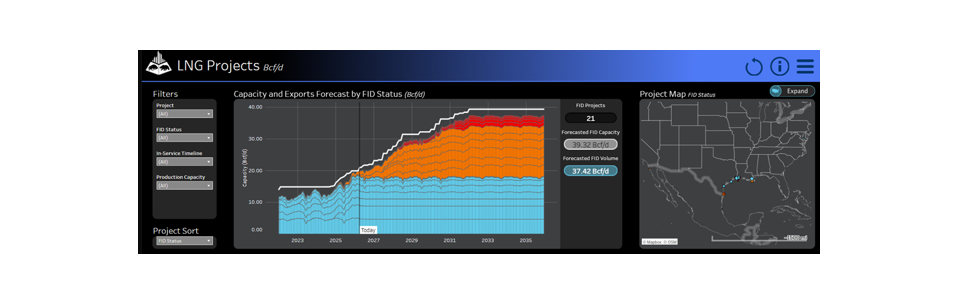
In our ‘LNG Tracker’ dashboard, US LNG production capacity grows to nearly 40 Bcf/d by 2032 (see East Daley’s long-term LNG forecast above from Energy Data Studio). However, facilities like Cheniere’s Sabine Pass or Rio Grande LNG, which can reach FID on incremental expansions of roughly 1 Bcf/d, are better positioned to capture new demand given their established header systems and strong track records.
Other LNG projects also face steep odds. In our view, Delfin LNG is unlikely to proceed given the logistical challenges of floating LNG, as delays with Altamira Phase 1 demonstrate. See East Daley Analytics’ ArkLaTex Supply & Demand Report for more on the Gulf Coast LNG outlook. – Oren Pilant Tickers: EQT, LNG, SM.
 Download Part II of East Daley’s Permian Basin White Paper Series
The Permian Basin’s next big buildout is already taking shape, but this time the driver isn’t crude oil. In The Permian Basin at a Crossroads: Why This Pipeline Boom is Different, East Daley Analytics’ latest white paper reveals how gas demand from AI data centers, utilities and LNG exports is rewriting the midstream playbook in the leading US basin. Over 10 Bcf/d of new capacity and $12 billion in investments are reshaping flows, turning the Permian into a gas powerhouse even as rigs decline. Read Part II: Why This Pipeline Boom is Different
Meet Daley, the Best AI Tool in Energy
Meet Daley, the newest member of our energy team. Our new AI assistant is live and available to all East Daley Analytics clients. Early feedback has been phenomenal. Daley is platform-specific and only pulls from East Daley’s own proprietary data and content. It’s not open-source or generic AI, but built to understand our structure, language and analytics. Whether you’re looking for a specific metric, forecast or explanation, Daley can get you there quicker. — Reach out to learn more about Daley!
The Daley Note
Subscribe to The Daley Note for energy insights delivered daily to your inbox. The Daley Note covers news, commodity prices, security prices and EDA research likely to affect markets in the short term.