



The Federal Energy Regulatory Commission’s (FERC) latest oil pipeline index reset looks small on paper. In reality, it could remove more than $1B of annual EBITDA upside from the liquids pipeline sector by 2028.
On April 24, FERC updated its oil pipeline rate index for the five-year period beginning July 1, 2026, shifting the adjustment factor to the producer price index for finished goods (PPI-FG) -0.55% from the prior PPI-FG +0.78% rate ceiling. The change amounts to only a 133-basis-point annual reduction in the allowed indexed tariff escalation, but the impact compounds over time across a massive transportation revenue base.
Under FERC’s indexing framework, liquids pipelines may raise indexed transportation rates annually so that tariffs keep up with inflation. The formula for the ceiling level is tied to the PPI-FG data published monthly by the US Bureau of Labor Statistics, plus or minus a five-year adjustment factor set by FERC. The agency determines the adjustment factor by comparing pipeline cost-of-service data for the prior five years with the economy-wide PPI-FG data, yielding a more sector-specific measure of inflation.
The index year runs from July 1 through June 30, meaning FERC’s revised rate begins affecting pipeline revenue in the second half of 2026, then becoming a much larger full-year earnings headwind in 2027 and beyond.
 East Daley Analytics models pipeline earnings in our Financial Blueprint models, as part of our midstream equity coverage available in Energy Data Studio. A wide array of companies operate oil pipelines that will see rate impacts, including Energy Transfer (ET), Enbridge (ENB), ONEOK (OKE) and Plains All American (PAA).
Using our Form 6 liquids pipeline dataset, we modeled the effect across 369 pipeline assets by annualizing 3Q25 results, reflecting incomplete 4Q25 reporting for some operators. The sample generated ~$45.6B of total revenue, including $40.4B of transportation revenue, and roughly $29.7B of EBITDA. Transportation revenue represented nearly 89% of total revenue, making it the clearest proxy for indexed tariff exposure.
To isolate the impact, East Daley held volumes and operating costs flat and modeled only the change in allowable tariff escalation under the old and new index methodologies. The analysis assumes 2.4% annual inflation and compares the transportation revenue path under the prior and current FERC frameworks.
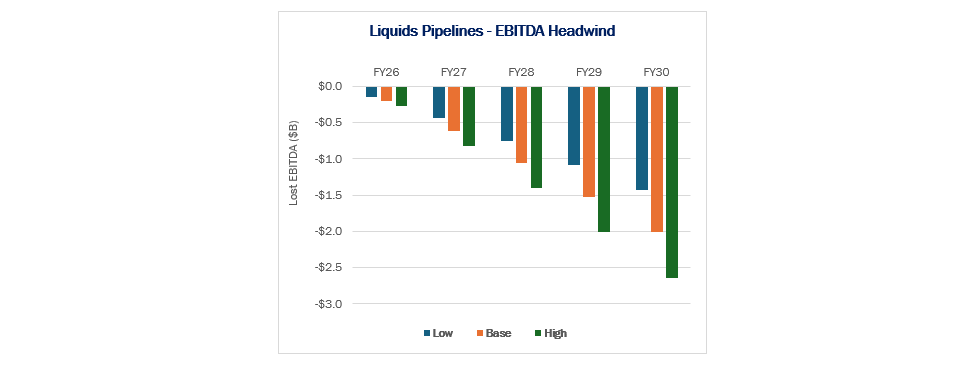
The result is a meaningful divergence in future earnings power. Under a full-exposure scenario where all transportation revenue is effectively indexed and fully flows through to EBITDA, the revised methodology creates a headwind of roughly $269MM in 2026, $820MM in 2027, $1.4B in 2028, and more than $2.0B by 2029 (see figure).
Not all transportation revenue is fully exposed to FERC indexing, however. Some pipelines operate under negotiated rates, committed-rate contracts, market-based tariffs or cost-of-service structures, limiting direct index sensitivity. To account for those differences, East Daley modeled three capture scenarios based on varying levels of indexed revenue exposure and EBITDA flow-through.
To be clear, we do not expect EBITDA will decline outright for the affected pipelines vs current levels. Instead, the calculations quantify the reduction in future EBITDA upside relative to the prior index methodology. Operators can still offset the headwind through higher volumes, system expansions, commercial optimization and non-indexed revenue streams. But the revised framework materially lowers the inflation-linked earnings tailwind many investors have historically embedded into liquids pipeline models.
The impact is amplified because the lower index compounds annually. Each year’s reduced ceiling escalation becomes the base for the following year’s rate increase, causing the earnings gap between the old and new methodologies to widen over time. That dynamic explains why the impact appears manageable in 2026 but becomes materially larger by 2028 and beyond.
Past inflationary cycles demonstrate how the sector can meaningfully gain from indexed tariff changes. When inflation rose sharply in 2022 and 2023, many liquids pipelines successfully captured substantial indexed rate increases on uncommitted tariffs, although outcomes varied significantly by basin, contract structure and competitive dynamics. The same mechanism will now work in reverse.
Bottom line: FERC’s new oil pipeline index methodology does not eliminate the inflation protection embedded in liquids pipelines, but it materially reduces it. A seemingly small 133-basis-point reduction in annual indexed tariff escalation translates into potentially a $1B-plus reduction in long-term EBITDA upside across Form 6 liquids pipelines as the lower rate path compounds over time.
See East Daley’s Financial Blueprint models in Energy Data Studio for more information. – Jaxson Fryer Tickers: ENB, ET, OKE, PAA.
Download Part II of East Daley’s Permian Basin White Paper Series
The Permian Basin’s next big buildout is already taking shape, but this time the driver isn’t crude oil. In The Permian Basin at a Crossroads: Why This Pipeline Boom is Different, East Daley Analytics’ latest white paper reveals how gas demand from AI data centers, utilities and LNG exports is rewriting the midstream playbook in the leading US basin. Over 10 Bcf/d of new capacity and $12 billion in investments are reshaping flows, turning the Permian into a gas powerhouse even as rigs decline. Read Part II: Why This Pipeline Boom is Different
The Daley Note
Subscribe to The Daley Note for energy insights delivered daily to your inbox. The Daley Note covers news, commodity prices, security prices and EDA research likely to affect markets in the short term.