



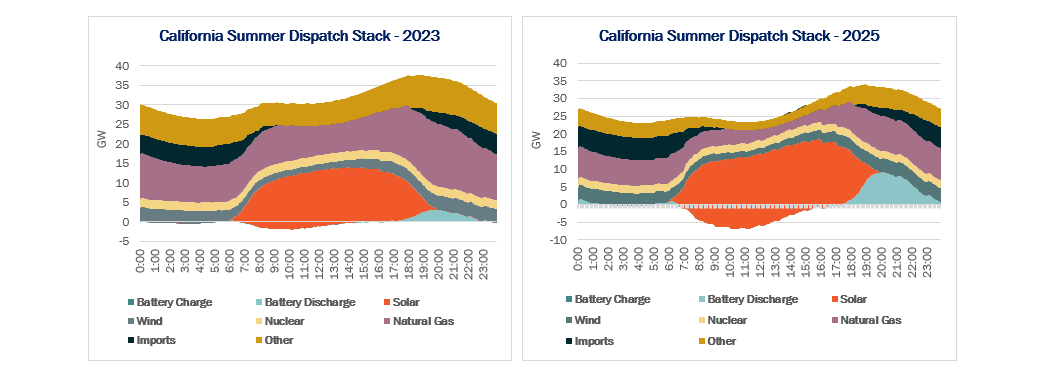
California’s transition toward renewable generation backed by batteries is sapping natural gas consumption, even as electricity demand growth tied to data center development continues to rise across the state.
In February, the California Public Utilities Commission ordered utilities to procure 6 GW of additional non-fossil capacity by 2032 to address reliability shortfalls resulting from growing electricity demand. At the same time, East Daley Analytics estimates announced data centers could add nearly 8 GW of incremental power demand in California by 2030, increasing the need for flexible generation resources during periods of elevated load.
California is hardly alone in embracing renewables, especially solar, but it stands out for its aggressive deployment of utility-scale batteries. The state currently has 15 GW of battery capacity installed to backstop 25 GW of solar generation. While gas demand continues to increase in many markets with growing renewables penetration, working as a natural complement to variable renewables dispatch, California’s battery component is proving particularly effective at displacing gas load.
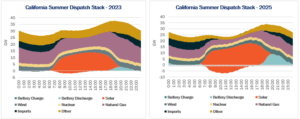
California’s dispatch stack has shifted materially since 2023 as rising solar and battery penetration reshape gas-fired generation patterns. During daylight hours, growing solar output increasingly suppresses net load from other power sources, while excess midday generation is used to charge battery storage systems (seen as negative values in the charts above). In the evening, batteries release stored electricity back onto the grid when solar generation declines, helping support the initial evening ramp in demand.
In the 2023 summer, gas-fired generation remained a dominant source of reliability support across most hours of the day, averaging roughly 10 GW during daylight hours and rising to nearly 16 GW during the evening peak. Solar generation peaked near 14 GW, while battery discharge contributed only about 3 GW during the evening ramp.
By the 2025 summer, California’s solar and storage buildout had materially altered intraday dispatch. Peak midday solar generation increased to nearly 20 GW, more than 40% above summer 2023 levels, while evening battery discharge capacity roughly tripled to nearly 9 GW during peak hours (see chart above). At the same time, average daytime gas generation declined nearly 55% to roughly 4.5 GW as gas accounted for a substantially smaller share of midday generation. However, evening gas burn remained elevated near 10 GW to support reliability as solar output declined.
The growing impact of solar and batteries on California gas demand is clear: The state’s utilities and power producers consumed 1.3 Bcf/d on average for power generation in 2025, down nearly 500 MMcf/d since 2022, according to Energy Information Administration (EIA) data.
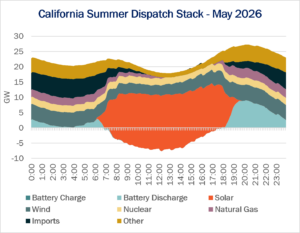 Early trends in the 2026 summer suggest the transition to solar and batteries continues to eat away at gas use (see figure at right). Midday gas generation has fallen further during periods of high solar output, while battery storage increasingly manages the initial evening ramp. However, gas-fired generation remains critical to maintain reliability during evening periods, after battery discharge tapers later in the night.
Despite declining daytime utilization, California still maintains more than 40 GW of installed natural gas-fired capacity. The transition is also occurring as ~3.3 GW of gas-fired generation capacity is expected to retire by 2030. At the same time, EIA data shows more than 10 GW of planned battery storage additions and nearly 8 GW of planned solar capacity through 2031, compared with only minimal planned gas-fired additions.
Bottom Line: California points to long-term risks to gas demand as battery deployment spreads to other markets. The state’s evolving dispatch profile shows renewable and battery storage growth are cutting into natural gas generation, though not eliminating dependence on thermal sources altogether. While renewable penetration continues to reduce average utilization, accelerating load growth from data centers should sustain the need for flexible gas-fired capacity to support the state’s power markets.
See East Daley’s West Coast Supply & Demand and Macro Supply & Demand reports for more on the implications of California’s renewables buildout. – Kritika Gaikwad.

Download Part II of East Daley’s Permian Basin White Paper Series
The Permian Basin’s next big buildout is already taking shape, but this time the driver isn’t crude oil. In The Permian Basin at a Crossroads: Why This Pipeline Boom is Different, East Daley Analytics’ latest white paper reveals how gas demand from AI data centers, utilities and LNG exports is rewriting the midstream playbook in the leading US basin. Over 10 Bcf/d of new capacity and $12 billion in investments are reshaping flows, turning the Permian into a gas powerhouse even as rigs decline. Read Part II: Why This Pipeline Boom is Different
The Daley Note
Subscribe to The Daley Note for energy insights delivered daily to your inbox. The Daley Note covers news, commodity prices, security prices and EDA research likely to affect markets in the short term.