



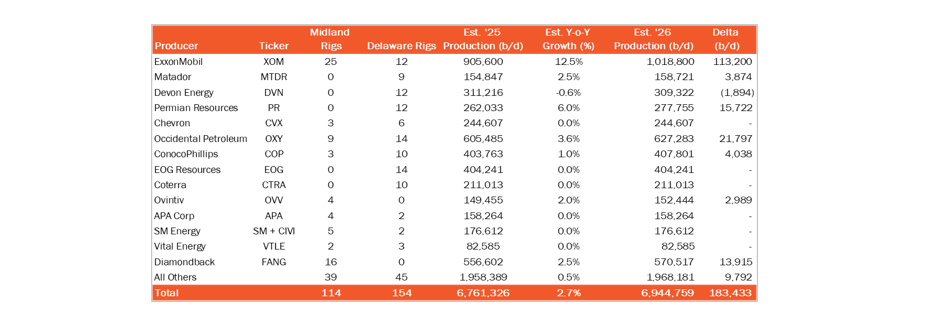
With 4Q25 earnings wrapped up, East Daley Analytics’ survey of Permian producer guidance reveals two distinct camps: ExxonMobil (XOM), and the rest of the upstream. Exxon is prepared to carry the industry’s water amid an otherwise modest outlook for oil supply growth in 2026.
Our survey of 14 public operators in the Permian Basin points to 2.7% growth in oil production in 2026, or ~183 Mb/d (see table). Of the 14 companies, half expect flat output this year.

Exxon is the clear outlier. The major guided to 12.5% production growth in the Permian in 2026, or ~113 Mb/d. XOM is running the most rigs in the basin, 37 total between the Midland and accounts for over half of the supply gains producers anticipate in the basin. Excluding Exxon, Permian guidance would decline to 1.2% growth this year.
The only other producer calling for relatively robust growth in 2026 is Permian Resources (PR) at 6.0%. Occidental (OXY), the second-largest Permian oil producer after XOM, has guided to 3.6% growth.
Only Devon Energy (DVN) is predicting a dip (-0.6%) in its oil production in 2026. DVN is consolidating its $58B merger with Coterra Energy (CTRA), and the combined company will provide full-year guidance once the merger closes, expected in 2Q26.
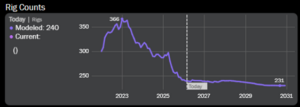 The modest Permian growth guidance comes as no surprise given lower WTI prices and declining rig counts through most of 2025. A total of 240 rigs are currently drilling in the Permian Basin, down 57 from a recent peak of 297 rigs in April ’25 (see figure from Energy Data Studio). That month brought “Liberation Day,” the start of President Trump’s sweeping tariffs on global trading partners, which sank oil prices from around $80/bbl to under $60 by the end of the year.
WTI prices have moved up sharply in the last two week due to the war with Iran, trading near $100/bbl on Friday. Despite the heady gains, East Daley does not anticipate any major upward revisions to producer guidance for the balance of 2026.
We believe most operators would be averse to changing course so soon after setting expectations with investors. Moreover, the binding constraint in the Permian is associated gas takeaway. Several producers called out in their 4Q25 earnings calls that growth depends on the start of new gas pipelines, including the Blackcomb and Hugh Brinson projects, which won’t start until 4Q26. Instead, East Daley sees higher prices linked to uncertainty in the Middle East as an opportunity for producers to hedge and shore up balance sheets. – Alec Gravelle Tickers: CTRA, DVN, OXY, PR, XOM.
 Download Part II of East Daley’s Permian Basin White Paper Series
The Permian Basin’s next big buildout is already taking shape, but this time the driver isn’t crude oil. In The Permian Basin at a Crossroads: Why This Pipeline Boom is Different, East Daley Analytics’ latest white paper reveals how gas demand from AI data centers, utilities and LNG exports is rewriting the midstream playbook in the leading US basin. Over 10 Bcf/d of new capacity and $12 billion in investments are reshaping flows, turning the Permian into a gas powerhouse even as rigs decline. Read Part II: Why This Pipeline Boom is Different
Meet Daley, the Best AI Tool in Energy
Meet Daley, the newest member of our energy team. Our new AI assistant is live and available to all East Daley Analytics clients. Early feedback has been phenomenal. Daley is platform-specific and only pulls from East Daley’s own proprietary data and content. It’s not open-source or generic AI, but built to understand our structure, language and analytics. Whether you’re looking for a specific metric, forecast or explanation, Daley can get you there quicker. — Reach out to learn more about Daley!
The Daley Note
Subscribe to The Daley Note for energy insights delivered daily to your inbox. The Daley Note covers news, commodity prices, security prices and EDA research likely to affect markets in the short term.